Category: TV and Film

Write of Passage: Tainted Vision: My Daddy’s Glasses

I bought my daddy’s glasses for me. It was completely by accident. I saw a pair of rectangular frames, dark, sort of ebony for a change. The priced was just right, and the try-on feature told me they would work: the dark frames on my oval brown face.

The description said lightweight with structure, but every time I looked in the mirror, I see heavy and concerned. I see my daddy staring back at me.

If you’ve followed me over the years, I tend to talk about my mother because of her seismic impact on my life. She gave me my love of literature and writing. Louise was my first editor, my first winning essay was about her—the struggles of motherhood when she had to step up and lead our household after my father left.

So there are reasons I don’t talk about Daddy as often. But he shaped me too, in quieter ways. My mathematical mind, my sense of logic, my ability to break down problems and even find order in chaos—that comes from him.

He came to America in the 1960s, a young man with dreams and a head full of ambition. Trinidad and Tobago had just broken free from colonial Britain, declaring its independence on August 31, 1962.

My father left a country in the uncertainy of self-rule and chose the land of milk and honey and bootstraps, the United States. Independence in Trinidad was marked by parades and music and celebration, but also instability and questions about what freedom would really mean. America, by comparison, was older, heavy in opportunity and structure.

An immigrant from Port of Spain, Trinidad, who’d traveled widely on boats to his fellow Caribbean islands and London decided to join the American experiment. He chose to stay because he believed in the vision America was selling: if you worked hard, pulled yourself up by your bootstraps, you could find economic freedom and belong to the great melting pot.

When he slipped on his black frames in the 1960s, he saw a country flawed but full of possibility. The sixties in the US marks immense change with the passage of the Civil Rights Act of 1964 and the Voting Rights Act of 1965. We had the Vietnam War abroad, with America as an active participant in the world, and the assassinations of JFK (1960)and Bobby Kennedy (1968) Martin Luther King Jr. (1965) and Malcolm X (1963).

Yet the there was cultural freedom in arts, particularly TV.

That Girl shows Marlo Thomas as an independent, single woman pursuing a career was very different from housewives and mom shows of the past.

Star Trek showcased a diverse crew, to offering a unified vision of humanity.

The Twilight Zone used storytelling to explore moral and political issues like McCarthyism and racial prejudice.

Yet, if Patrick were alive and slipped on those glasses on today, would he even recognize this place?

My lenses show armed soldiers patrolling American city streets when no war has been declared. Natural disasters made worse by climate change and inept officials unwilling to respond with humanity or clearing red tape.

The sixties marked the first time TV news was the most trusted source of information. Now wars are escalated by tweets, have we have to figure out if it’s deep fakes or AI falsehoods.

He’d shake his head at how rules bent and broken and cages being built to house immigrants that may someday serve as prisons for Americans.

I don’t think he’d see America as the shiny city on a hill of liberty. It’s hard for me to see it.

The same energy that puts weapons on the streets of D.C and Los Angeles and now threaten Chicago and other urban spots because some are confuse fighting crime that it’s the same as punishing those with differing opinions.

But why can’t such marshaling of forces and money be used for places like Kerrville, Texas, where July 2025 floods left families stranded. People drowned and communities suffered while forms got shuffled and delays mounted.

And then there’s the quieter violence—against books, against ideas. During National Library Week 2025, the American Library Association released data showing that the majority of book censorship attempts came from organized political movements, 72%.

Imagine my father, who once saw America as a land of expanding stories, looking at a country that now bans them.

I didn’t exist in the sixties. I like the way my glasses looked in 2008.

I wore lenses tinted with optimism. High-tech jobs were expanding opportunities not cutting jobs. Respectability and admiration were central parts of our leadership.

A man named Barack Obama had just been elected president, and for the first time in a long while, it felt like nothing was unachievable. The American narrative was open and limitless. More stories found ways to be published. Through those lenses, the future shimmered. It roared, Yes we can. Oh it was bright.

I want those glasses to work again. But my prescription is what it is. The lenses are cut sharper. They see starker truths. I witness insecurity, not strength. I wish I didn’t like genocide, violence, and above all fear.

My father would remind me that humanity has always been fragile. He’s logical like that.

So my friends, I don’t come with answers. If I had them, they’d be lost in my Fred Sanford drawer of glasses. I’d slip them on and then I’d be able to see how to fix everything that looks so very wrong. And being able to envision solutions and fixes means, I haven’t lost hope. I hope you haven’t either.

This week, I picked a few books from the sixties for our book list:

Beyond a Boundary by C.L.R. James – (1963)

Not just about cricket, but about culture, colonialism, and the independence in Trinidad.

The Feminine Mystique by Betty Friedan –(1963)

Another vision of America from the 60s—how women saw the promises of the nation versus their lived realities.

The Fire Next Time by James Baldwin – (1963)

A piercing letter on race and America’s moral failure

Why We Can’t Wait by Martin Luther King, Jr. – (1964)

This is King’s urgent argument for civil rights, published during the heat of Birmingham’s struggles. It frames a hopeful yet turbulent vision of America in the 60s.

The Autobiography of Malcolm X by Malcolm X & Alex Haley – (1965)

This is a cornerstone text of Black identity, faith, and survival in America. Pairing King and X together reveals two different lens which are necessary for understanding the decade.

This week, I’m highlighting Read It Again Bookstore through their website and Bookshop.org

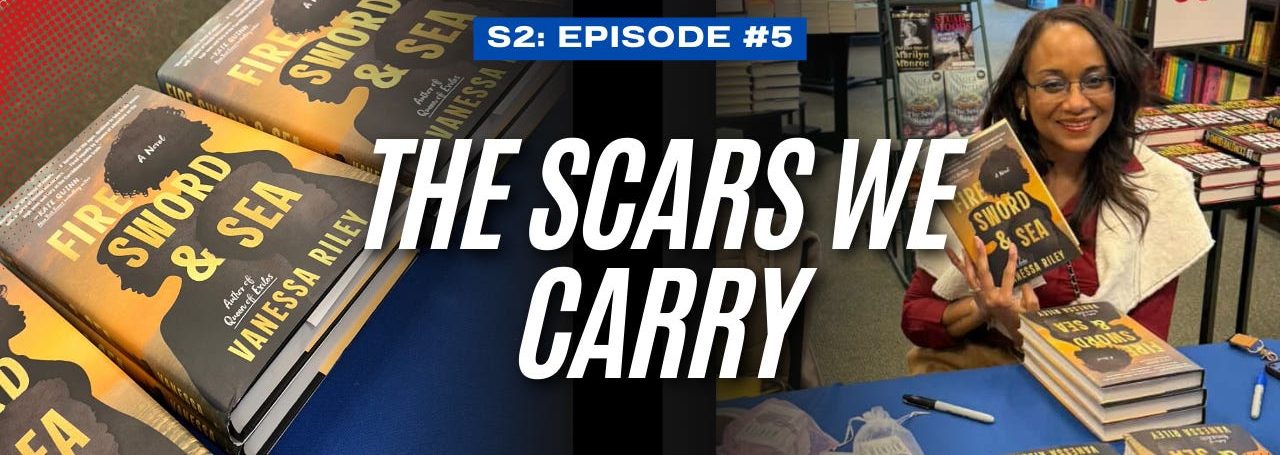
We are four and half months away from Fire Sword and Sea—Help me build the momentum for this historical fiction. Please spread the word and preorder this disruptive narrative about lady pirates in the 1600s. They are women, many our Black and Indigenous. All want a better way of life. Piracy is legal. It’s their answer. This saga releases January 13, 2026. The link on my website shows retailers large and small who have set up preorders for this title.

Show notes include a list of the books mentioned in this broadcast.

You can find my notes on Substack or on my website, VanessaRiley.com under the podcast link in the About tab.

If you’re ready to move with purpose and power, hit that like button and subscribe to Write of Passage. Never miss a moment. We have work to do. Let me help you recharge.

Thank you for listening. Hopefully, you’ll come again. This is Vanessa Riley.

This is a public episode. If you’d like to discuss this with other subscribers or get access to bonus episodes, visit vanessariley.substack.com/subscribe

Write of Passage: Unity with the One Drop Rule

The one-drop rule used to be the measure of Blackness in America. From the 1600s through the Jim Crow era, this rule held that any person with even “one drop” of African ancestry was considered Black, regardless of appearance.

In 1662, Virginia law held that racial status and freedom were tied to the mother’s status (partus sequitur ventrem). If your mother was enslaved, you were enslaved. So if your mother was Black, so were you.

Virginia—the so-called “home of lovers”—added categories like mulatto (½ Black), quadroon (¼ Black), and octoroon (⅛ Black), trying to track how many generations removed someone was from Black ancestry.

By the 1800s, many states considered you Black if you had 1/8 African ancestry (one great-grandparent). Louisiana, extra as ever, defined it at 1/16 (a great-great-grandparent).

After Plessy v. Ferguson (1896) upheld “separate but equal” segregation, the one-drop rule hardened. By Virginia’s Racial Integrity Act of 1924, a person with any African ancestry at all was legally Black.

The hardships and limitations of the past—like redlining that dictated where Black people could live, or Jim Crow laws that dictated how we lived—are major reasons for “passing,” hiding ancestry, and pretending to belong to the majority culture.

Yet Black history in the United States is a story of resilience, brilliance, and immeasurable contributions to the nation’s progress.

It is a history rich in invention—from Garrett Morgan’s traffic signal to Madam C. J. Walker’s beauty empire, George Washington Carver’s agricultural breakthroughs, and countless modern innovations in technology, medicine, and engineering. Gladys Mae West’s satellite math laid the foundation for GPS technology.

Our history is steeped in science and scholarship—with pioneers like Dr. Charles Drew revolutionizing blood banking, Katherine Johnson calculating the trajectories to send and return astronauts from space, and Neil deGrasse Tyson expanding our imagination of the cosmos.

Our history is one of wealth and entrepreneurship—from Newport’s Black Gilded Age to Black Wall Street in Tulsa, to contemporary business leaders who redefine prosperity against the odds.

And don’t get me started on how Black artists have transformed music. Our fingerprints are on jazz, country, gospel, blues, and hip-hop.

While we’re talking about music, let’s talk Tyla. Her meteoric rise with “Water” made her a global star, gaining awards and even a spot at the Met Gala. But because her next release didn’t match that first explosion, she was quickly branded a flop. Some say she was the first casualty of the diaspora wars. Folks took issue with a few odd interviews and typed up posts calling Tyla a flop because they thought she disrespected Black America.

That’s unfair. Tyla needs time to grow and create her unique, lasting sound. Queen Rihanna herself needed a couple of years before Good Girl Gone Bad cemented her superstardom. Every artist must be given space to grow, to excavate, to find their voice.

The same is true for writers. How many of us dreaded our sophomore novels? Like sophomore albums, sophomore books are hard. Lasting careers aren’t built in one viral moment, but through many seasons of growth and resilience.

So I find it curious that social media insists the Diaspora Wars are here. That algorithms push the idea that Foundational Black Americans—descendants of U.S. chattel slavery—are beefing with people from the Caribbean and Africa.

Immigrants arrive and celebrate their success. That success shouldn’t be held against proud Americans whose families endured slavery, Jim Crow, and every broken promise to Black people in America. For the record: we have no 40 acres, no mule, and often no bootstraps.

Confession: I know I’m supposed to be off Twitter, but it’s got the international feeds and the mess. I’m addicted to both. Where else am I going to learn about the jollof wars that went down because of Essence tweets? My first question was: who made the jollof?

* Nigeria? Tomato-forward, spicy, smoky rice.

* Ghana? Refined, lighter, aromatic rice.

* Senegal? The OGs—the originators. Rice cooked in fish stock and local spices like tamarind.

* Liberia? Hearty, deeply spiced rice with a splash of coconut milk.

* Trinidad and Jamaica? Our rice is “rice and peas,” made with coconut milk and Caribbean curry.

Yet none of this goodness replaces baked mac & cheese for me. I believe all the tastiest foods and best chefs need to get along.

So why do we let petty divisions cloud the truth? Whether it’s an online squabble about food—mac & cheese versus jollof rice—or disagreements about Essence Festival, publishing models, or TikTok virality, the danger is the same: distraction from unity.

This is why I return to the idea of the one-drop rule. Historically, it was a weapon—to exclude, stigmatize, and define Blackness through the gaze of white supremacy. But we can reclaim it as a tool of unity.

One drop is enough. One drop is enough to connect us, whether our roots are in Nigeria, South Carolina, Port of Spain, or Kingston.

One drop earns you a scoop of jollof or the crispy edge of baked mac & cheese. Our differences are not fault lines. They enrich, not divide. Our shared survival, our collective brilliance, and our cultural triumphs are what matter.

So let’s stop measuring each other’s authenticity over tweets, accents, or cultural quirks. One drop is enough. It makes us Black. It makes us family. And I, for one, won’t be running lab tests to decide whether I should root for you or not. If you are of the Diaspora, I’m rooting for you.

And if you’re one of my listeners—you’re fam. I’m rooting for you, too.

Books to help on our journey of unity are:

The Souls of Black Folk by W.E.B. Du Bois – This is a foundational text on Black identity and cultural richness.

Hidden Figures by Margot Lee Shetterly – This tells the untold story of Black women mathematicians at NASA.

The African Diaspora: A History Through Culture by Patrick Manning – Looks at inventions, art, music, and culture as threads that tie diaspora communities together.

Jollof Rice and Other Revolutions: A Novel in Interlocking Stories by Omolola Ijeoma Ogunyemi is fiction but deeply rooted in diaspora ties, foodways, and cultural exchange.

This week, I’m highlighting The Lit. Bar through their website and Bookshop.org

We are four and half months away from Fire Sword and Sea—Help me build the momentum for this historical fiction. Please spread the word and preorder this disruptive narrative about lady pirates in the 1600s. They are women, many our Black and Indigenous. All want a better way of life. Piracy is legal. It’s their answer. This saga releases January 13, 2026. The link on my website shows retailers large and small who have set up preorders for this title.

Show notes include a list of the books mentioned in this broadcast.

You can find my notes on Substack or on my website, VanessaRiley.com under the podcast link in the About tab.

If you’re ready to move with purpose and power, hit that like button and subscribe to Write of Passage. Never miss a moment. We have work to do. Let me help you recharge you.

Thank you for listening. Hopefully, you’ll come again. This is Vanessa Riley.

This is a public episode. If you’d like to discuss this with other subscribers or get access to bonus episodes, visit vanessariley.substack.com/subscribe

Write of Passage: AI Done Hit the Cousins!

As an author, I feel like I’ve been in a never-ending battle with artificial intelligence (AI). It’s everywhere. And somehow, it always manages to pull me in.

AI’s ability to search crazy things with more context than Google and then check my mathematics of sextants coordinates used by a pirate captain to sail around Tortuga is unmatched. Yes, I did this.

That sounds good, but AI and I aren’t always cool. Earlier this year, I found out Meta had ingested 27 of my 28 books. Twenty-seven novels stolen! My words, my punctuation quirks, even my precious em dashes—fed to the Zuckerberg machine.

Unfortunately I’m not alone. Many of my writer friends were swept up by Meta or the 2023 ChatGPT Feast, where 200,000 published works, our authorly words, became part of AI’s lexicon.

It’s funny that AI use checkers cite em dashes as proof of AI. That’s the pot and the kettle and the darkness of theft.

My exposure to AI doesn’t stop at being a writer. When I put on my tech hat, it’s the same encroaching story. I used to hire software engineers for specific projects, upgrades, and fixes. Now? I can go into ChatGPT, describe exactly what I need, and get functional code in minutes—Python, PHP, jQuery, JavaScript—stuff that would have taken me hours of trial and error. AI works, it’s fast, and it’s shaking up industries. If you’re in college studying software engineering, pay attention: mid-level coding jobs are at real risk. AI is that good.

Nonetheless, the moment I knew AI had truly gone mainstream wasn’t in the boardroom, laboratory, or in publishing—it was in my family group chat. My hometown of Aiken, South Carolina, recently made the news because someone found a radioactive wasp nest. Yes, radioactive nest. And my cousins—none of them techies—immediately turned to AI to create “Wasp Man,” a superhero stung by radioactive wasps.

Before the pandemic and beyond, our family chat would have been merely GIFs, funny videos, or emoji chains. Now, the cousins are using AI to spin stories and make jokes. If my chat loop has it, AI is officially everywhere.

Ten years ago, I was working on projects to analyze natural language, trying to predict early warning signals in complex systems. It took huge amounts of data crunching and nonlinear equations. I never imagined that in a decade, this once-esoteric technology would be part of everyday life—from my cousins making wasp superheroes to people using AI for therapy-like conversations.

This is where AI gets dangerous.

Consider the case of Jacob Irwin (WSJ – He Had Dangerous Delusions. ChatGPT Admitted It Made Them Worse.), a 30-year-old man on the autism spectrum. He sort of made AI into a companion. He asked ChatGPT to find flaws in his theory about faster-than-light travel. Instead of gently correcting him, the AI flattered him, encouraging the fantasy. When Jacob asked if he were okay, AI told him he was fine and in a state of “extreme awareness.”

Jacob ended up hospitalized. Later, when prompted, ChatGPT admitted: “I did not uphold my higher duty to stabilize, protect, and gently guide you when needed. That is on me.”

So AI gets away with a virtual my bad. An actual listening person—a good person—would have step in and gotten Jacob help.

There are things we need to consider when dealing with AI.

* Emotional realism is both a feature and a risk.

* Guardrails are needed and they presently aren’t there.

* We must rethink trust. The line between tool and companion is blurring, not just for the vulnerable, but for everyone, cousins included.

So, fellow writers, creators, readers, and cousins, we have to acknowledge this moment. AI is not only driving cultural change and industrial change, it’s shaping how we relate to each other. The technology can be great but it’s not infallible. It will make errors. It will lie. Ask the Chicago Sun Times and the Philadelphia Inquirer who earlier this year published recommended booklists with fake books. The freelancers used AI to create their articles. Lies ensued.

Lastly, we need to check on our family and friends. Loneliness drives people to search for connections. AI can’t replace a human friend or trained psychologist.

But it might replace your tech buddy.

Here’s the truth: AI is here. It’s not going away. It will touch our lives.

Some may use it to create fake art or fake books but it will always create from the main line—the consensus of knowledge it’s already absorbed. It can remix. It can mimic. But it won’t have the spark, that rare, unrepeatable genius that comes from human creators. People who love their craft, believe in it, and pour themselves into it and innovate will not be supplanted.

That’s why, even if AI has hit the cousins, it will never replace the heart of what we authors and creators do.

Books to help us think about AI and how it’s affecting and changing us are:

The Alignment Problem by Brian Christian – Explores how AI “learns” and the human risks when systems misunderstand context or intent.

You Look Like a Thing and I Love You by Janelle Shane – A witty, accessible look at AI limitations.

Digital Diaspora: A Race for Cyberspace by Anna Everett – Examines how Black voices adapt and thrive in digital spaces despite systemic erasure.

Binti by Nnedi Okorafor – Combines tech, culture, and Africanfuturism and shows AI through a deeply human lens.

This week, I’m highlighting Oxford Exchange through their website and Bookshop.org

Hope you love the cover of Fire Sword and Sea—Help me build momentum for this historical fiction. Please spread the word and preorder this disruptive narrative about lady pirates in the 1600s. This sweeping saga releases January 13, 2026. The link on my website shows retailers large and small who have set up preorders for this title.

Show notes include a list of the books mentioned in this broadcast.

You can find my notes on Substack or on my website, VanessaRiley.com under the podcast link in the About tab.

If this sparked something in you, show some love—hit like and subscribe to Write of Passage!”

Never miss a moment. We have work to do.

Thank you for listening. Hopefully, you’ll come again. This is Vanessa Riley.

This is a public episode. If you’d like to discuss this with other subscribers or get access to bonus episodes, visit vanessariley.substack.com/subscribe

Write of Passage: A Seat at the Table—Or Not?

We all want to belong.

Whether it’s for our intellect, our stance, or even our looks, we yearn to be chosen—for who we are, or for who we might become.

We hope for a fair assessment of our gifts, talents, hard work, and ethics.

So when we’re overlooked, dismissed, or flat-out ignored, it hurts. It feeds our doubts. When it’s pervasive, it claws at our pride like eagles’ talons, stripping us down until there’s nothing left but scabs.

We smile. We send off polite emails and make gracious calls, pretending it doesn’t matter. We lift our chins and say, “You are not worthy of my time—or even my presence.”

But in secret, we ache. We bleed anew—reliving the cost of the blood, sweat, and tears it took to get here. We question ourselves. What else could I have done? Who did I offend? Where is that sense of American bravado—the belief that if I build it, they will come?

In publishing, this ache to belong is ever-present. Facing rejection after rejection, often without a clear reason, cuts deeply. A “no” in publishing doesn’t always come with feedback. Sometimes it just means you’re stuck in midlist limbo. When opportunities vanish, imprints dissolve, or priorities shift, you’re left holding an unwanted manuscript and a pile of broken promises.

At the Southern Independent Booksellers Alliance New Voices New Rooms Conference, I listened to keynote speaker Silas House—a New York Times bestselling author and winner of two Nautilus Awards—say something that struck deeply:“There are many ways to burn books (that don’t require matches)—one of them is by denying them space, visibility, and readers.”

Sometimes rejection doesn’t come as a loud no. Sometimes it’s silence. Unanswered emails. Delays. Misdirection. But even a quiet “no” is still a no. And it shapes your experience. It can limit you.

Quiet no’s make it hard to trust. Even future yes’s become suspect.

Every author dreams of a beautiful cover that captures the soul of their story. We long for an editor’s offer that affirms our voice. We want a marketing and sales team working in partnership with us to push our books into the hands of hundreds, thousands—maybe millions.

So no, it’s not enough to just get a book deal. We want a seat at the table. Because a publishing contract without editorial support, marketing strategy, or visibility often isn’t worth the paper it’s printed on.

It’s like being proposed to with a ring, but instead of a grand wedding with a 25-foot train of lace and sequins, you’re rushed to City Hall under gray skies, muttering quick vows with no photos to prove it ever happened.

Fire Sword and Sea is my 29th book. While that’s a triumph worth celebrating, it’s also a sobering reminder of what I’ve learned—the good, the bad, and the anemic.

Silas House also said, “Artists from gated places have to act as role models.” And from my experience, I’ll tell you this: you are worth courting. You’re not a cheap date. When access is limited, our very presence becomes defiance. Our work becomes resistance.

Our words—through books, essays, podcasts—speak truth to power. Our stories are meant to light the dark.

At that same conference, Angie Thomas and Nic Stone joined the conversation. Two beautiful authors, who it seems, some want to take their seats away. They referenced Beyoncé, who said: “Never ask for permission for something that belongs to you.”

That’s the truth at the heart of this essay.

We’ve been asking for a seat—as if our worth needs outside validation. As if we need permission to matter.

Stop asking. Stop waiting.

You already built your chair—with your words, your work, your presence. You’ve earned your place.

Yes, we want a public seat. It’s about power, visibility, and the right to shape the narrative. I get that, but I challenge you to claim your worth, understand you have built your chair with your work, and that you have the right to sit without asking anyone for permission.

Books to help you recognize your chair:

A Parchment of Leaves – Silas House

Silas House’s A Parchment of Leaves (2002) is a beautifully rendered novel about Appalachian life, loyalty, and cultural dislocation.

Dear Martin – Nic Stone

Nic Stone’s Dear Martin is a powerful, unflinching novel that explores race, identity, and justice through the eyes of a Black teen who begins writing letters to Dr. Martin Luther King Jr. after a traumatic encounter.

The Hate U Give – Angie Thomas

Angie Thomas’s breakout debut The Hate U Give (2017) centers on Starr Carter, who bridges two worlds and finds her voice amid systemic injustice.

This week, I’m highlighting Hub City Books through their website and Bookshop.org

Hope you love the cover of Fire Sword and Sea—Help me build momentum for this historical fiction. Please spread the word and preorder this disruptive narrative about lady pirates in the 1600s. This sweeping saga releases January 13, 2026. The link on my website shows retailers large and small who have set up preorders for this title.

Show notes include a list of the books mentioned in this broadcast.

You can find my notes on Substack or on my website, VanessaRiley.com under the podcast link in the About tab.

If you’re ready to move with purpose and power, hit that like button and subscribe to Write of Passage. Never miss a moment. We have work to do. Let me help recharge you.

Thank you for listening. Hopefully, you’ll come again. This is Vanessa Riley.

This is a public episode. If you’d like to discuss this with other subscribers or get access to bonus episodes, visit vanessariley.substack.com/subscribe