As we focus on outdoor activities here at Regency Reflections, I would like to spend sometime highlighting one meant for lovers, lovers of scenic views and food, the picnic (picnick). By the time of the Regency, communing with nature and enjoying natural activities became the rage. What better way to indulge both passions, outdoors and food, than by dining al fresco.
Photo from http://myaustendreamworld.com
The ingredients of a fine picnic are the weather, the guests, the place, and the food.
The Weather
The weather should be warm and sunny. Most picnics provide a linen cover on the ground for the participants to sit and eat their meals. Thus, if it has rained for several days, the saturated ground will wet the coverings and bring mud and damp clothes to the event. We wouldn’t want to spread consumption. Moreover, if one tried to have a picnic in 1816, the year without a summer, the temperature would be too cold or worse too snowy to have had an enjoyable picnic.
The Guests
Selection of the guest needed to be done with the same care as choosing ones for an indoor dinner party. Participants will be sitting very close together, even leaning near the next person. Thus, social people with excellent conversation would be preferred. Unmarried people still required chaperones, so the hero won’t be sneaking away with his single heroine… unless he’s sure not to be caught.
The Place
The place to hold the picnic must be selected wisely. Because of the need for the eyes to experience nature, the environment for the picnic should be as inviting as the food. Yet, choosing a picturesque place might mean settling on an out of the way flat plain on the moors, or a hill like Box Hill, the famed picnic spot in Emma. Box Hill, the summit of the North Downs in Surrey, is set up high and framed in boxwood trees, oaks, tall grasses, and wild flowers. Perfect for a picnic.
Source: Wikicommons. Panoramic View of Box HillPhoto from the Movie Emma (1996 British TV)
The provisions for the picnic can consists of tables to hold the food, the food, plates, cloths, servants to dish the food, servants to do the setup and the clean up, the linens, etc. These goods and servers can require wagons or carriages for transportation to and from the location. If the scenic spot was too out of the way, servants had to walk and carry picnic fare from the closets point of access (the road, etc.) to the picnic spot.
The Food
Food for the picnic can be arranged one of two ways. (1.) The picnic organizers can assign foods for each of the participants to bring. This ensures that no foods are duplicated. Each participant must bring enough food for all of the picnickers. (2.) The other way is for the organizer to supply it. This option was mainly chosen by the wealthy as an extension of showing off their good fair just as if the picnic were an indoor dinner at a ball.
The common foods supplied were pre-sliced cold roast and cow tongue (also sliced). Deviled eggs were popular. Once the egg is boiled, it’s sliced in half and the yolk is removed. The yolks are mixed with pepper, Worcester sauce, salt, and mustard and then returned to the inside of the boiled egg half. No addition of mayonnaise (1756 Charles de Lorraine, duke of Mayenne) to worry about spoilage.
I found a reference to walnut sandwiches and fruit sandwiches. Walnut sandwiches were made from chopped walnuts mixed with cheese and spices and served on thinly sliced bread. Fruit sandwiches were made with stiff stale bread topped with thin slices of bananas and pineapples sprinkled with sugar. After it sets up with the fruit juices penetrating the bread, it is cut into little cakes and served with whipped cream (or clotted cream).
The drink offered would be a popular beverage that can be served at ambient temperatures (not too cold and not hot): lemonade, white wine claret, or a sweet madeira wine.
All foods should be easy to port and serve the picnic-goers to show the host as a considerate and generous person as well as match the beauty and ease of the natural surroundings.
So, if your weekend permits, have your servant or dear hubby fetch a sandwich and blanket and dine al fresco Regency-style.
References:
“Cookery”, by Amy Richards, published in 1895
Andrew Hubbell, How Wordsworth Invented Picnicking and Saved British Culture. Romanticism, Volume 12, Number 1, 2006, pp. 44-51
MyAustenDreamworld.com
Janeaustensworld.wordpress.com
Timothy Morton, Radical Food: The Culture and Politics of Eating and Drinking, 1790–1820, vol. 1 (New York: Routledge, 2000), pp. 3–8.
My mother was the first female entrepreneur I ever met. She started selling baked goods during tax season while my father prepared income taxes for clients in our home. I distinctly remember her brownies—one of my favorite treats—being sold right on our porch to delighted customers. But my mother wasn’t just an entrepreneur; she was a serial entrepreneur. She took that experience and built a bookstore—Goldenrod Christian Bookstore—in the booming metropolis of Aiken, South Carolina. And for those familiar with Aiken, you’ll catch the joke in that description.
Midnight Release Party of A Wager at Midnight at The Book Worm Bookstore
A love of books has always been deeply ingrained in my family, which made it all the more distressing when larger businesses noticed the niche my mother had carved out. Since there wasn’t another Christian bookstore for miles, these businesses began selling Bibles and offering similar services, cutting into her business. I suppose at any stage of success, there will always be competition, challenges, and obstacles that try to stop you. You just never know what each day will bring.
One of my fondest memories of Goldenrod was an item my mother kept by the register—a small, round coin. Some were blue, others red, and each had the words “To It” stamped on the top. It didn’t make sense to me at first. When I asked her about it, she gave me that knowing smile and said, “This is for everyone who delays their dreams, thinking they’ll get around to it.” Then she placed the coin in my hand and said, “See? Now you have a round to it. So go after what you want.”
The idea of “a round to it” is a powerful concept. It represents the ultimate form of procrastination—the assumption that we will always have another moment, another chance. But nothing in life is promised. We shouldn’t make plans assuming X, Y, or Z will happen down the line, nor should we sit still waiting for the perfect moment.
By the time you hear this podcast, I will have released my 26th book into the world, A Wager at Midnight. I will also, in all likelihood, be very tired because we celebrated with a midnight release party. (Side note: I probably should’ve named it A Wager at 10 PM—then I could have gotten a full night’s sleep! But I digress.)
The event was an incredible opportunity to celebrate this book, an indie bookstore that I love, and the readers who believe in my voice and mission—supporting women, female entrepreneurs, and female authors. Because despite what anyone may tell you, being an author is a business. Our product is our words, codified in a book. We have to market, advertise, reach new customers, and most importantly, appreciate every reader—whether they pick up a book from a library, buy it from a bookstore, or listen to it through headphones. Every reader is a valued customer.
At the midnight party, we celebrated in style. The menu featured chimichurri sauce with a range of crudité vegetables, Megan Sussex’s lemon honey olive oil cake with cream cheese frosting, baked donuts with chocolate ganache and floral sprinkles, holiday meatballs, and an array of cheeses—including a particularly tipsy drunk goat cheese. There was plenty of food, and even greater joy in watching people savor what had been created with love and care. Perhaps I’m a serial pleaser because I want people to enjoy my words, but if I throw a party, I want them to enjoy the food, too.
So consider this message your round to it. Wear that outfit you’ve been saving for a special day. Take the trip you’ve been thinking about. Start the business that’s been living in your head, even if the present situation feels uncertain. Celebrate everything—whether it’s a major victory or simply the fact that you’re still in the game.
And as we celebrate book number 26, A Wager at Midnight—Stephen and Scarlett’s story—we honor a narrative that intertwines a fight against the blood disease sickle cell anemia with a love story between a Duke and a Viscountess, who place a wager that will be settled at the end of A Wager at Midnight. At its heart, this book is about two people devoted to medicine and helping others, yet unsure if they can have both love and their dreams. But luckily, Stephen and Scarlett get a round to it.
Books that can help bolster the celebration now mindset:
So celebrate today. Party today. Because nothing is promised, and you deserve your flowers—or your holiday meatballs—even if it isn’t an official holiday. You deserve a celebration.
Show notes include a list of the books mentioned in this broadcast. This week, I’m highlighting “The Book Worm Bookstore” through Bookshop.org. You can find my notes on Substack or on my website, VanessaRiley.com under the podcast link in the About tab.
Thank you for listening. Hopefully, you’ll come again. This is Vanessa Riley.
This is a public episode. If you’d like to discuss this with other subscribers or get access to bonus episodes, visit vanessariley.substack.com/subscribe
Someone said, “Reading is elitism,” and I knew immediately—we’re in trouble.
When people start calling books the problem, it’s never about books.It’s about control.
A mind that doesn’t read is easier to steer.Easier to distract.Easier to convince that vibes are enough and history is optional.
But reading—especially our reading—was once illegal.Punishable by death.
So no—reading isn’t elitism.It’s survival.
I saw a screed on Threads that made me stop and stare.“Reading is elitism,” the post declared.
It left me scratching my head.
Why now?Why is this sentiment surfacing at a moment when people are desperate to escape the hellscape we’re living in—when they’re trying to learn, to grow, to imagine ways to resist?
Is it something more sinister?
Because an algorithm shaped by bots and billionaires has no interest in a smart, savvy, or hopeful electorate. It wants control. A mind that doesn’t read—one that lives on vibes alone—is easy to steer. It will thrive on chaos. It shall be misled, distracted, and ultimately enslaved.
That post made me angry. The kind of angry that pulls my inner poet out of hiding.
Yes, Vanessa Riley has been known to write poetry. If you’ve read Island Queen, Sister Mother Warrior, The Bewildered Bride, and others, you’ve already seen my poetic bent threaded through the prose.
And don’t you have a new book out? Fire Sword and Sea, next week, Jan. 13? Ain’t nobody have time for all this.
No. Nobody does, but I made time. For I got big mad.I reached for the pen—or rather, the keyboard.
What came out was a poem I now call Between the Book and Me.
Between the Book and Me
Reading is a privilege, a refuge, a right sorely won.
So miss me with the BS, the apathy.Because I Know Why the Caged Bird Sings (Maya Angelou).
Maybe it’s my generation.For we came from a time when we were raised as Beloved (Toni Morrison),and hoped for Something Like Love (Beverly Jenkins),Only to learn we were an Invisible Man (Ralph Ellison),Never a Native Son (Richard Wright).
We sought out books to find The Souls of Black Folk (W.E.B. Du Bois),but kept our gaze fixed on librarians and mentors,for Their Eyes Were Watching God (Zora Neale Hurston).
And they knew what books to pick for our good.They understood which passage would give us hope.
When we learned that life—she—was No Crystal Stair (Eva Rutland),
They gave us books that fed a Hunger (Roxane Gay),
Because they knew we would ache when Things Fall Apart (Chinua Achebe).
They understood that verses on a page, in a hymnal, on a screen,would become Kindred (Octavia E. Butler)—Something to remember, to retain, to hug.
That touch, that warm embrace, when nouns and verbs paint pictures,Keeps the flames of imagination burning.It will stoke The Fire Next Time (James Baldwin).
Reading makes a difference.When peaceful with a psalm or enraged and ready to fight Fire Sword and Sea (Vanessa Riley),Try opening a book—keep going—Fill your soul with words and dreams.Get so full you must Go Tell It on the Mountain (James Baldwin).
So it makes me sad when some insistOur whole story lives only in the Narrative of the Life… an American Slave (Frederick Douglass),or the Incidents in the Life of a Slave Girl (Harriet Jacobs).
No. Black Boy (Richard Wright).No—Black girl.No bright child misled into craving The Bluest Eye (Toni Morrison).
Rise up from The Street (Ann Petry).Savor words as if they are rare,Growing sweeter when harvested in the mind like A Raisin in the Sun (Lorraine Hansberry).
If you read, you will learn this:That you are more than Sister Outsider (Audre Lorde).You are The Black Jacobins (C.L.R. James).You are an Island Queen (Vanessa Riley),Swaying to a Harlem Rhapsody (Victoria Christopher Murray).
You see, Between the World and Me (Ta-Nehisi Coates)—Between a book and you—AreA mother’s prayer,A grandmother’s wisdom,An ancestor’s war song.
So don’t turn your back on reading.Don’t dismiss the act our forefathers and foremothers chose, even under the penalty of death.
Reading isn’t elitism.It’s essential to survival.It’s defiance, spelled out.It’s the way to live.
This week’s book list is in my poem. Go to the show notes. Get the full list. I’m supporting Novel Neighbor through their website and Bookshop.org.
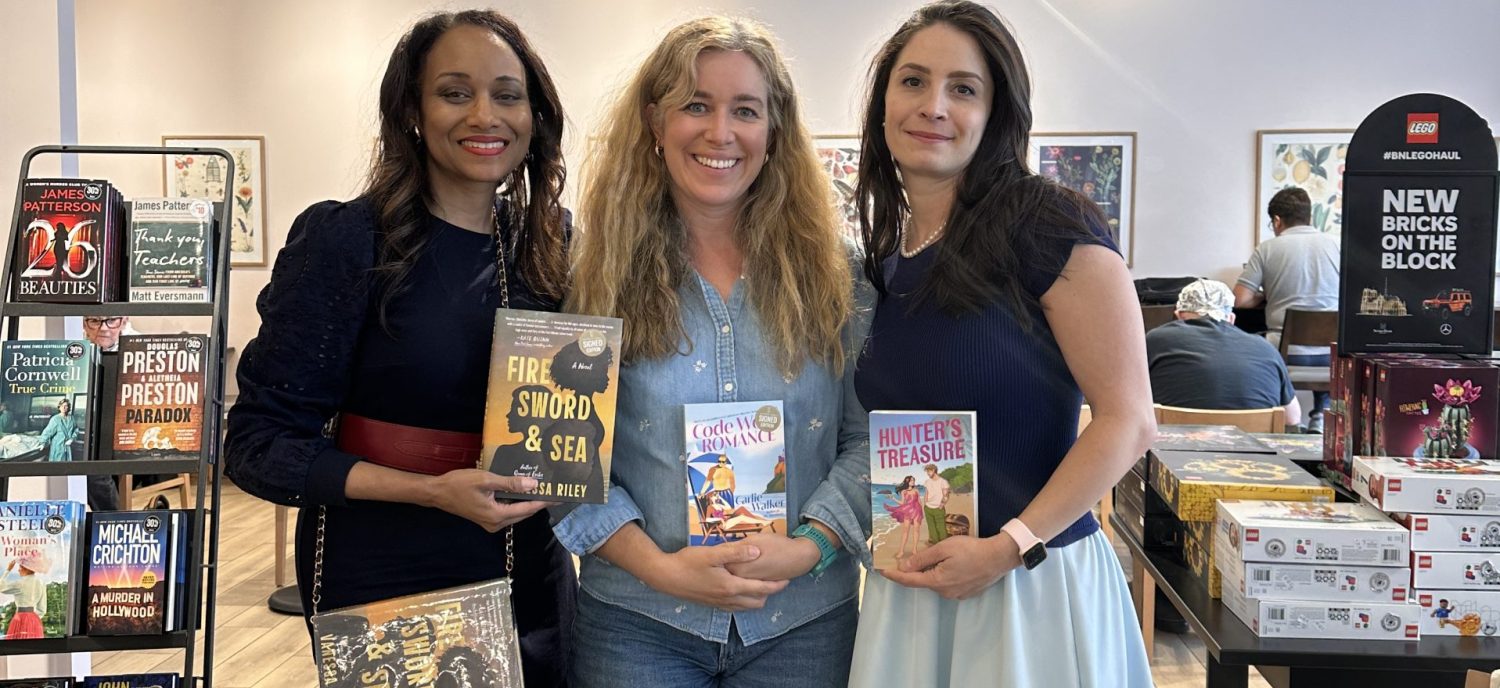
We are less than a week away from the release of Fire Sword and Sea. She comes out on January 13th, 2026. Caribbean women pirates—That’s Black pirates, integrated crews, and secrets—of those who sailed the seas for adventure, a better life, or because they darn well felt like it. Read their truth. Get folks talking about this book.
Consider purchasing Fire Sword and Sea from Novel Neighbor or one of my partners in the fight, bookstores large and small who are with me.
Come on, my readers, my beautiful listeners. Let’s get everyone excited to read Fire Sword and Sea.
Show notes include the poem mentioned in this broadcast.
You can find my notes on Substack or on my website, VanessaRiley.com , under the podcast link in the About tab.
Enjoying the vibe? Go ahead and like this episode, share, and subscribe to Write of Passage so you never miss a moment.”
Thank you for listening. I want you to come again. This is Vanessa Riley.
January 10 – Gwinette Library with Jasmine Sinkfield (Click the image for Registration Links)
Jan. 12 – Resist Booksellers in Petersburg, VA
Jan. 13 – Release Day – Loyalty Books in DC with Victoria Christopher Murray
Jan. 14 – Park Books in Severna Park, MD with Kate Quinn
Jan. 15 – FoxTale Books in Woodstock, GA with Simone Umba
Jan. 16 – Novel Neighbor in St. Louis, MO with Pat Simmons
Jan. 17 – Black Pearl Books in Austin, TX with Ali Hazelwood
This is a public episode. If you’d like to discuss this with other subscribers or get access to bonus episodes, visit vanessariley.substack.com/subscribe
To celebrate the release of Madeline’s Protector, we’re running a special contest. Starting today through next Friday, May 3, we’ll feature thought-provoking questions at the end of each post. To enter the contest, you’ll need to supply a thoughtful answer to the question. The grand prize winner at the end of the week will receive a brand new Nook.
But the contest doesn’t stop there. Each day a new post goes up (Monday, Wednesday, and Friday) we’ll be giving away mini-prizes for that day only. Here’s a list of the prizes:
Fri, April 26—$10 starbuck’s gift card – Nancy !!!!!!!!!!!!!!!!!!!
Mon, April 29–$itune card
Wed, May 1–$10 Amazon Gift certificate
Fri, May 3—A paperback of Madeline’s Protector.
And that’s not all. If you want to be eligible for a second chance to win the Nook tablet, you need to refer someone else to Regency Reflections. (Note: if you bring someone on over, make sure the other person’s comment mentions that you referred them).
If you don’t feel comfortable leaving a comment to enter the giveaway, or if you want yet a third chance to enter, you can follow this link and enter the contest once on this site: https://contest.io/c/8jhitnpz
Now, on with this post.
In my debut novel, Madeline’s Protector, my heroine, Madeline St. James, has been shot. She’s drenched to the bone, and the hero, Justain Delveaux, Lord Devonshire, has to stop the bleeding, remove the bullet, and keep her from going into shock.
Devonshire is a complex Regency gentleman. He’s a veteran of the Peninsula War and is familiar with patching men up, but a woman?
Luckily, Lord Devonshire is also a reforming rake. His acute knowledge of unmentionables helps him save Miss St. James ‘s life without indecent action. (This is a Christian Regency. 🙂 )
Thus, I researched stays. Stays is the English term for the corset during the Regency. Prior to the 18th century, corsets were stiff devices made to support and shape a woman’s body. They were made of silk, silk brocade, linen, or even leather. They were boned throughout with whalebones, making the unmentionables stiff and restricting.
Here are some pictures of corsets from the 1760 and early 18th century.
Picture A.
Picture B
One of the things that struck me about these corsets were the bright colors of these Pre-Regency pieces. Also, it was not uncommon to find over 150 wale bones inside the corset to sculpt the female shape. Ouch.
These units laced in multiple directions. Picture A laces in the front and the back. Picture B laces on both sides under the arms. So trying to unhook these models varied from corset to corset. Thus attempting to loosen one of these to aid a stricken woman’s breathing could be useless or fraught with disaster. We’d hope a gentleman wouldn’t need to grope a woman trying to determine where the laces of the corset were positioned.
Typically, the corset did not sit against the skin. A chemise of cotton chintz or muslin covered the body sitting underneath the corset. This continued to be the norm during the Regency.
Between 1785-1800’s, corsets were typically light in color. Boning is used to stiffen, but metal springs are also used to help shape. Fabric choices are quilted silk taffeta,
Picture C
linen, and chintz. Hand darned eyelets routed the laces to keep on the corset. These corsets laced in the front and/or back. (Picture C)
By 1804, a new type of corset was created. These were soft without the all over use of whalebone. These corsets were constructed from cotton, cotton sateen, cord quilting, and/ or cotton satin. The bust could have a drawstring to help provide shaping. It might also use a busk, a long strip of metal or flat bone to stiffen the corset. The following picture show a long rectangular section between the breasts (Picture D). That is the busk.
Picture D
These corsets used laces in the back (Picture E) to close the garment. Sometimes these corsets are called Long Corsets.
Therefore, the hero during the Regency more often than naught guessed correctly, if he attempted to loosen the corset by finding laces along the heroine’s back.
A man during the Regency did not have to be a rake or a womanizer to have knowledge of a woman’s undergarments. Having a sister, mother, or a dandy as a brother could provide the needed information. Some dandies wore Apollo or Cumberland Corsets. The male corsets bound the stomach and were constructed with whalebone to stiffen.
Picture E
One of the more interesting things, I found during my research is that girls also started
Picture F
in corsets (Picture F) at a young age. I suppose if you become accustomed to something early in life, it is easier to bear.
Today’s question: If you lived during the Regency and found yourself in a dire circumstance would you:
A. Do everything possible to save yourself, not caring of any possible ramifications.
B. Do everything possible, but you would worry about potential scandals or compromise.
C. Risk everything to a point. Your family name and position could not be threatened.
Please add your comment below. You could be today’s daily post winner. All comments will be entered into our grand prize drawing. For an extra chance to win click here: https://contest.io/c/8jhitnpz
Sometimes, there are words and events designed to provoke, to get under your skin, to upset the balance of your peace. Over time, I have learned that I can’t react to everything. There’s just too much noise. But some things are too important to ignore.
Right now, libraries are under threat. Institutions we’ve funded to preserve history, like Arlington National Cemetery, are erasing lesson plans that once provided a comprehensive view of our past. If you’re searching for biographies of heroic Americans who happen to be Black, who happen to be a woman or Spanish or Latin, they are no longer easily accessible. The only thing they haven’t done is dig up the graves. And honestly, I wouldn’t put it past them. Nothing seems too indecent or radical anymore. If you’re willing to close libraries or hinder children’s ability to learn about the sacrifices made to build this country, there’s no travesty or crime you won’t justify.
Keep reading Vanessa Riley’s Write of Passage! This post is public so feel free to share it.
Meanwhile, natural disasters rage across the country. Fires burn on both coasts, tornadoes tear through communities, and people are in pain. Leadership feels absent, leaving many confused and struggling to make sense of it all. And if you’re an author in the midst of this chaos, you’re still expected to go out there and promote your book.
Writers and artists often struggle with feeling that their work is inconsequential, that it can wait. But if the pandemic taught us anything, it’s that time is a gift, and there are no guarantees that we’ll see the next moment. The work we do now matters.
If you follow me on social media, you know I strive to keep my posts positive. I share stories that uplift fellow authors and women’s initiatives. I find joy in the simple things, like Megan Sussex gathering us all in a virtual group chat to bake cakes in beautiful pots or arrange flowers on our tables. I’ve seen people take that extra moment to make meals special, to nourish themselves, to create beauty in the everyday. And let me be clear—this kind of joy is a form of resistance. We should never stop embracing it.
But let’s get back to booking. Why is it that artists are expected to hold back from promoting their work in times of crisis? If a professional chef were asked to stop baking because wildfires were raging, we’d find it absurd. If a police officer were told to abandon their duty because of book bans, we’d question the logic. Yet authors are often made to feel guilty for marketing their work when the world is in turmoil.
I wish my job were just writing. But it’s not. Writing is only one piece. There’s also editing, revising, and—perhaps the most exhausting part—letting people know that my book exists. I wish I had an assistant to do it all. I wish we lived in the old days when publishers handled marketing, but that world no longer exists. Today, agents and editors look at an author’s social media presence as part of the package. That doesn’t mean you can’t get a contract without it, but having a strong online presence certainly helps. And maintaining that presence requires effort.
I gravitate toward the social media spaces that bring me joy. I’m active in many places because I have to be, not necessarily because I want to be. I use Facebook for recipe discussions, Instagram for visuals, and I pop into other platforms when necessary. Ideally, marketing wouldn’t be my primary strategy, but here we are.
For those struggling with promotion in the midst of chaos, know this: talking about your book is part of your job. Empathy and support for others are important, but so is your book. If you are traditionally published, sales determine future contracts. And sales won’t happen if people don’t know your book exists. Publishers won’t consider external factors when evaluating your performance. It’s on you to ensure your book gets noticed.
Even when the world is on fire, you have created something meaningful. You’ve brought characters to life, and they deserve to exist in the imaginations of readers. But that won’t happen if you don’t speak up. Your book, the product of months or even years of labor, deserves to be shared with the world.
I’ve said it before on this podcast: We write, we win. Your words matter. They might feel small in the grand scheme of things, but they provide escape and joy to readers. Someone out there needs the story you’ve crafted. But they won’t find it if you don’t tell them about it.
So, take a deep breath, lift your head, and shout from the rooftops: I have a book coming out! And speaking of books, I’m Vanessa Riley, and my next novel, A Wager at Midnight, the second book in the Betting Against the Duke series, is on its way. In this book, you’ll meet Scarlet, a bold young woman who dreams of studying medicine at a time when it is forbidden for women. She can’t even attend a lecture unless she disguises herself as a man. But Scarlet is determined, and she may just find an unexpected ally in a brilliant, slightly uptight physician from Trinidad who happens to love Jane Austen and cassava pone.
See what I did there? I told you about my book, even though the world is in chaos. I poured my heart into writing this story. I’ve included detailed historical notes for those who want to learn more. I hope A Wager at Midnight encourages readers to think deeper about sickle cell anemia, the importance of medical care, and, of course, the magic of falling in love—even when the world feels like it’s unraveling.
Authors and all artists, hear me. Let your art see daylight. Scream from the mountaintops. Walk on water shouting, Look what my hands have wrought with the talent given to me for a time such as this. Never be the servant who buried his talent in the ground because he was afraid of loss, of looking foolish, or of incurring some greater wrath. You are here. Now is the time. You’ve completed a project. Stand tall in your accomplishments and let the world know. Don’t bury your talent in the ground. Don’t waste a moment waiting for a better time. There is nothing better than now, for you don’t know who desperately needs to hear or see what you’ve done—to help them with their healing journey, to take the next step in their creative walk. Your words could be the fuel to propel them forward. What you do in creating changes the world to tilt a little more toward good.
And if you’re feeling stuck or unsure how to promote your own book, here’s a list of books that can help you step up your marketing game:
Platform: Get Noticed in a Noisy World by Michael Hyatt – A guide to building a strong personal brand and online presence, showing authors how to stand out and attract readers in an oversaturated market.
Black Boyby Richard Wright – A powerful memoir that can inspire writers to confront the harsh realities of life, self-doubt, and the struggle for personal truth and purpose. Wright’s story will resonate with anyone feeling like their work or life doesn’t matter.
And what you’ve been blessed to do as a writer or artist is to create. So, A Wager at Midnight– full of laughs, it’s a celebration of community told in a historical setting. Buy my book, she says proudly. As an artist, your book deserves to be seen, and your work deserves to be celebrated, even if the world’s burning.
Show notes include a list of the books mentioned in this broadcast. This week, I’m highlighting BookPeople through Bookshop.org. You can find my notes on Substack or on my website, VanessaRiley.com under the podcast link in the About tab.
Thank you for listening. Hopefully, you’ll come again. This is Vanessa Riley.
Wright, R. (2004). Black Boy. Harper Perennial Modern Classics.
This is a public episode. If you’d like to discuss this with other subscribers or get access to bonus episodes, visit vanessariley.substack.com/subscribe
The title of this essay changed from ‘What the Hell’ to ‘Was I Really a DEI Hire?’—and then reality set in. 2025 was a year of whiplash: pride, disbelief, resistance. But I’m still here, with a new book coming in January, while finishing my thirty-first one. I’m a storyteller. And in 2026, I’m coming in hot. I choose ASCENT.
From Hellscape to Angel Wings – 2026, Come Get Me.
The title of this podcast essay changed several times before it settled into place. It moved from I’m So Glad We’re Almost Out of 2025 to What the Hell to Was I Really a DEI Hire? I want to talk to the manager—and then, reality and sense came to me.
That confusion, the whiplash between pride, dishonor, and disbelief, pretty much sums up my experiences in 2025.
Don’t get me wrong—there were extraordinary moments. This podcast and speaking to you weekly is something I enjoy. Speaking in front of a packed ballroom of over 800 people at the Jane Austen Society Conference was breathtaking. Traveling to NY for a girls’ trip and to share the stage with Eloisa James was amazing. Some of these moments I never imagined would happen. When I first began writing Regency-era stories, I encountered resistance from people who insisted diversity in that time period was “fantasy.” As if Black people magically appeared in 1865, to be liberated from talent-sourcing camps by a war between the states. And in 2025, we still love our euphemisms. We’re supposed to forget all the atrocities with no second thoughts about lineage and history.
For the record, there are entire civilizations—from African kingdoms to complex global networks—that existed. Beauty and scholarship and faith existed before the transatlantic slave trade and colonization.
But we’re encouraged not to think about any of that.
When I first said I wanted to write about Black women pirates, I’m pretty sure they thought it would be like the movie Girls’ Trip, just set on the high seas.
I don’t think the collective thinking—the industry, the world, the gatekeepers—was prepared for the history I uncovered. I found depth. I chose danger. I decided to make visible a period in the 1600s where women took a stand and chose violence. They fought for what they wanted.
And I see the conversations beginning. Folks are judging the women through modern lenses. Unfortunately, women are still critiqued the same way. They are made into third-class citizens for not choosing to have children, for not choosing to be a mammy, for choosing careers, ambition, and self-determination over settling. These are conversations we still need to have.
And we will have them—with fire, with sword, and seas of truth.
My upcoming novel is a naked exploration of feminine power. It’s leadership forged in chaos. It’s truth standing upright in a collapsing world.
Back to Publishing:
The landscape for 2025 has been equally surreal. Peers have had books that weren’t available on launch day. Others couldn’t get their advance copies because they were held up by tariffs in Canada. I’ve had porch pirates steal mine. Tracking shipments has become a chase that maybe my Lady Worthing might be able to solve. Who knew that a billion-dollar corporation couldn’t get a handle on UPS? Perhaps this is only affecting a few. Perhaps, it’s only an issue for certain publishers. Perhaps, only certain authors are in limbo. Oh, the DEI of it all.
And yet.
Here I am, a day or two before the New Year, finishing a WIP, my thirty-first book. Thirty-one. This one will be published in 2027—the fourth Lady Worthing mystery, Murder in St. James’s Park. I don’t think I killed enough people. Severn House will have to tell me. So no matter how chaotic or frustrating the system can be, there’s nothing I would rather do than sit down and write stories.
I’m a storyteller.
I come from a Southern mother who loved literature and a Caribbean father from who loved—loved—loved—telling stories. Storytelling is not just what I do. It’s what I am.
So as I step into 2026, my word—my declaration—is ASCENT.
Ascent means growth upward. Earned success. Elevation in status and income. It carries momentum. Inevitability. It is not loud, but it’s unstoppable.
My ascent into 2026 will be the manifestation of faithfulness. When you are faithful to your craft, faithful to your words, the seeds you planted return as harvest. The earth becomes gentle because you have cared for it. So no matter how crazy—and I mean crazy—this world becomes, no matter how many disappointments or kicks in the teeth you endure, do not give up.
Because if you give up, they win.If you give up, every lie they told gets declared as truth.
They don’t care that you’re tired.They never cared that you’re human.They do not care if you’re sane.
They will rejoice when you are defeated. That side partied too much in 2025.
And I’m sorry. I have my dancing boots on right now. I’m too stubborn to give up. I’ve come too far from where I started from. And I have too many stories to tell.
So my question to you, in this moment of crazy:Are you a leader?Are you a Moses?A Harriet Tubman?Or are you the woman who wrote Kindred? An Octavia Butler, gifted with foresight, who’ll break stereotypes and venture into the unknown.
I suspect some of you are. I know that yourascent is not accidental; it’s strategic. You’ve swung for the fences, and it’s your time.
So in 2026, choose ASCENT and leap into this new year with expectations. Let no one—and I mean no one—stop your rise.
This week’s book list is a mixed bag of identity, womanhood, and manifest:
Kindred by Octavia E. Butler – This is a foundational work on power, survival, and historical memory. It’s a classic. Let it be your entry to her storytelling.
Sister Outsider by Audre Lorde – This collection of essays examines womanhood as a site of power, insisting that Black women’s differences, their anger, and lived experience are sources of knowledge, survival, and transformation.
Lara by Bernardine Evaristo – This novel traces lineage, migration, and identity across centuries, reflecting inheritance and storytelling.
We are fifteen+ days away from the release of Fire Sword and Sea. She comes out on January 13th, 2026. Caribbean women pirates—That’s Black women pirates who sail the seas for adventure, a better life, or because they darn well felt like it. Imagine what their truth is. Help me get folks talking about this book.
Consider purchasing Fire Sword and Sea from Mahogany Booksellers or one of my partners in the fight, bookstores large and small who are in this fight with me.
Come on my readers, my beautiful listeners. Let’s get everyone excited for Fire Sword and Sea and 2026.
Show notes include a list of the books mentioned in this broadcast.
You can find my notes on Substack or on my website, VanessaRiley.com, under the podcast link in the About tab.
Enjoying the vibe? Go ahead and like this episode, share, and subscribe to Write of Passage so you never miss a moment.”
Thank you for listening. Hopefully, you’ll come again. This is Vanessa Riley.
This is a public episode. If you’d like to discuss this with other subscribers or get access to bonus episodes, visit vanessariley.substack.com/subscribe
While I wait for Ruth to arrive, let me remind you what’s going on this week at Regency Reflections.
To celebrate Moonlight Masquerade, we’re running a special week-long contest. Starting today through next Friday, March 22, we’ll feature Regency quiz questions at the end of each post. To enter the contest, you’ll need to correctly answer the questions in the comment section below. For every correct answer, your name will be added into the drawing for a $25 Amazon gift card . There will be five questions in all, which means your name can be entered up to five times (if you get all five questions right). The deadline to answer ALL CONTEST QUESTIONS will be Saturday, March 23 at midnight.
Today, I have the pleasure of interviewing Ruth Axtell and talk with her about her exciting new release, Moonlight Masquerade. Ruth, welcome to my porch. Can I get you something? Tea? A scone?
No. Well, have a seat in this freshly dusted wicker chair. My footman (i.e. the hubby) will stow your landau. My tulips need a bit more manure. Now, tell me what inspired you to write Moonlight Masquerade?
I first got the idea quite a few years ago, so the memory is quite sketchy, but I think it was a dream I woke up with. It was in regency times, and I remember an aristocratic lady and her butler, who wasn’t really a butler at all. That’s all I had to go on.
So the butler did it? That was a risk given the societal norms of the Regency.
It was a challenge to have a noblewoman attracted to her butler, when social strictures would have scarcely had her seeing him as a human being on her level. So, I used the fact that she was a French Republican (i.e., believing in the original ideals of the French Revolution and Enlightenment-liberty, fraternity, equality) to make her see her servants differently than the normal mistress would have.
Wow, that is different, and you had to master so many facts about the French Revolution on top of your normal Regency research.
There were so many facts about the Napoleonic Wars that it’s hard to pinpoint just one. I think the more I read about Napoleon, the more I discovered how much harm he did to the European continent, and specifically that he set France back about a hundred years because of all the wars he led it through. Whereas Britain went full-speed ahead in the industrial revolution, bringing prosperity to its populations, France’s manhood, it’s agriculture, and money to invest in factories was decimated for a long time to come.
Ruth, let’s go back to the butler, Mr. Rees Phillips. What are his best and worst traits?
His best traits are his faithfulness and sense of duty. He has helped support his widowed mother and sister for many years since his dad died bankrupt. He is a loyal employee of the British government. But, these exemplary traits are also his worst because they make him rigid and uncompromising in many way. They also cause him to accept a subservient role in the Foreign Office where he has toiled for years.
Is Lady Celine Wexham a good match for Mr. Phillips?
She is passionate and impulsive. These traits allow her to give her all to a cause or to those she loves. But they also cause her to act before weighing the consequences.
Before, I ask you about the juicy stuff, can you sum up what spiritual truth would have made a difference to your hero’s journey.
That God is above politics, patriotism, and nationalism.
Sounds like a lesson we can all take to heart. What about Lady Wexham?
That God is good and wants only the best for her.
Now that we’ve filled our religious quotient (this is RegencyReflections.com/ChristianRegency.com), let’s talk passion. How would rate the novel’s passion: smokin’ like Louisiana ribs, tepid like warm chamomile tea, deliciously layered by red velvet cake, or some other decadent food?
Slow, simmering burn like a dark chocolate laced with cayenne pepper. You don’t realize there’s a bite till it has melted in your mouth, and it’s too late to spit it out.
So Lady Wexham’s and Mr. Phillips’s first cayenne seasoned kiss takes place about midway in the story. When you wrote it, what was going through your mind? I know the rhythm of a romantic song can set the pacing of a love scene for me. Even a Hershey with almonds can create a spectacular smooch.
I am in my characters’ mind, so I am experiencing their motivations and feelings. I don’t need music or chocolate so much as just getting into that zone of who they are and what they’re experiencing at that particular point in time.
Ruth, I admire your talent. You were one of the first voices I found bringing Regency stories to the CBA. How would you describe your career?
I describe a writing career as a challenge, which you undertake because you are compelled to. Currently most writers are trying to transition and adapt to the new digital age of book publishing. I describe successful as able to get the spiritual message across in each story, AND be able to make a living at writing.
Well, a three-book deal from Revell does help pay a few bills. Maybe a couple of Sunday bonnets. Before you get back in your landau and finish viewing our apple blossoms, tell me what nugget of truth you want the readers of Moonlight Masquerade to take with them.
That two people finding each other and falling in love, and submitted to God, can transcend whatever temporal differences seem to stand in their way.
Thank you, Ruth for stopping by and letting me run on about Moonlight Masquerade.
Here’s today’s question. Enter a comment with the right answer for a chance to win.
The title of Moonlight Masquerade refers to a masked ball. Which of the following costumes would not be a typical one at a regency ball masque?
a) shepherdess
b) pirate
c) hula girl
d) Harlequin
When I was in school, I once had a saying, “Sleep you can get any old time, but grades last forever.” At the time, I meant it. It wasn’t the best mindset, but it fueled my drive to maintain a near-perfect grades. As an overachiever, I found comfort in metrics—things that could be measured, quantified, and tracked. That’s how I knew I was doing well. They were the invisible pats to the shoulders. You did good. With working divorces parents who just always couldn’t be there, numbers were a great substitute. Numbers gave me a sense of security, a tangible way to validate my efforts, to validate me.
Vanessa literally on a treadmill.
Unfortunately, I’m not alone. I believe the validation race is everyone’s personal kryptonite and the obsession starts young. My last year in elementary school, I won everything—the Citizenship Award, honors in science and math, and a spot on the honor roll. It was an amazing experience to be recognized by my teachers and the principal. But I remember vividly that same day, being called to a third-grade classroom to encourage my younger brother. He was upset because he hadn’t won anything. I had to gently explain to him that awards like these were given in sixth grade because students were preparing to transition to middle school. It wasn’t his time.
Still, it was difficult to celebrate my accomplishments while knowing he was in pain. Even though he wasn’t eligible for the awards, he still felt the sting of being left out. That’s what the constant chase for validation does to us—we seek it even when we don’t need it, even when it’s not our time to be evaluated or recognized. We keep chasing the numbers, keep running on the validation treadmill.
But the problem with numbers is that when you focus on them too much, you can lose sight of the journey. This isn’t just an issue for young people and students—it follows us into adulthood, into our careers, and for those of us who write, into the publishing world. As an author, numbers are everywhere. It starts with the word count—how many words it takes to complete a manuscript; how many get cut during editing. Then comes the timeline—how long it takes to get through copyediting. A friend of mine showed me how to take a manuscript that has been copy-edited and put it into Pages to track the number of revisions. And while that was cool to learn, it was just another number to haunt me, to obsess over, and to try to get right—whatever that means.
More publishing numbers: how quickly the book needs to be turned around, how many months, days to pub. And then, the numbers shift to reception—the number of reviews, Goodreads ratings, NetGalley and Eidelweis requests. The numbers don’t stop. They just change shape.
Once the book is out, the chase continues: the number of posts on social media, the number of followers, the number of subscribers. The formula for success remains elusive, and the pressure builds. Writers aren’t alone in this. No matter your field, numbers are always chasing you—performance metrics, annual reviews, engagement rates, sales quotas. The cycle never ends. And after a while, this constant pursuit can overshadow the real goal: growth, creativity, and fulfillment.
This endless race can lead to burnout. And burnout looks different for everyone. Some people cry. Some people yell. Some people run miles to clear their heads. Me? I bake deep-dish apple pies. My husband knows I’m in trouble when I start making a pie crust from scratch for no particular reason. He can hear how hard I’m chopping those apples. He sees the intricate lattice work I’m designing on the crust—each crimped edge and delicate braid a sign I’m trying to regain control in a world that feels overwhelming. That’s when he knows to bring me a latte or a pile of chocolate, because his wife is spiraling.
The truth is, we all need people who can pull us out of the chase, who can remind us to stop counting and start living. Rest is not a luxury—it’s a necessity. And rest doesn’t always mean sleep. Just as praying without ceasing doesn’t mean sitting still, resting is an active practice. It can be stepping away from the numbers, engaging in something that feeds your soul, or simply taking a breath. Rest looks different for everyone, but without it, we suffer. Our bodies wear down, our creativity dims, and our minds stop firing in the ways they need to. For a writer, that means losing the very words we work so hard to find.
How do we heal? How do we stop the obsession? I don’t know. We all tick differently. Some books that might help are:
The Courage to Be Disliked by Ichiro Kishimi & Fumitake Koga – A thought-provoking book based on Adlerian psychology that challenges the need for external validation and encourages self-acceptance.
Radical Acceptance by Tara Brach – Explores the power of self-compassion and mindfulness to break free from the cycle of seeking approval.
The Gifts of Imperfection by Brené Brown – A powerful read on embracing authenticity and letting go of the need for validation from others.
What Happened to You? by Oprah Winfrey & Dr. Bruce Perry – Looks at how past experiences shape our need for validation and how to heal from them.
Fiction provides great examples of validation in all stages. Before I Let Go by Kennedy Ryan deals with validation, self-worth, and healing for both main characters, Yasmen and Josiah, as they try to define their post-divorce evolving identities.
One of the reasons I loved writing Scarlet Wilcox in my upcoming novel A Wager at Midnight is because she has divorced that part of her brain that seeks judgment. She doesn’t care what others think unless it affects her family. Yet, as brave, bold, and daring as she is in seeking her path to bring medicine to those who cannot get it—those whom society deems ineligible or unworthy—she still slips into wanting validation from a physician, Stephen Carew. Scarlet is a good balance of all of us, and I loved writing those moments where she is free of cares and when she’s forced to face her fears.
So I am giving you permission to take a moment for yourself. If you take nothing else from this podcast, learn this: It’s okay to rest. It’s necessary to rest and not focus on numbers or being superhuman. If you don’t take care of you, your body, mind, and creative being, the world will chew you up body, dry up your spirit, and move on to the next overworked soul.
But you? You are the hero of your own story. And every hero needs rest. So take off your cape, stretch it into a hammock, and allow yourself a moment of peace.
Show notes include a list of the books mentioned in this broadcast. This week, I’m highlighting Eagle Eye Bookshop through Bookshop.org.
Subscribe for free. Get Vanessa’s take on current events, publishing—challenges and opportunities—drawing from her journey as an indie author turned traditionally published powerhouse: 26 novels and counting.
Thank you for listening.
This is a public episode. If you’d like to discuss this with other subscribers or get access to bonus episodes, visit vanessariley.substack.com/subscribe
I love nonfiction. It plays a needed role in our psyche. I hunt for it and use these tomes in my research.But fiction is as essential as the air we breathe.When lives were never fully recorded, storytellers do the remembering.
Still a Storyteller
Right before I sat down to finish this essay—and to record this podcast—I completed the copy edits on my thirtieth book.
Thirty books. Nine with traditional publisher, Kensington Books. I am proud of all the writing I’ve done, but I’m particularly proud of A Deal at Dawn, a novel I’ll be talking about more in 2026. I’m proud of it for a simple, powerful reason: I told a story, a complete story, one with a beginning middle, climax and end.
When I was growing up, being called a storyteller didn’t always carry a positive meaning. Sometimes it was a euphemism for someone who told lies. Years ago, I was interviewed on a podcast by a preacher who genuinely could not understand why fiction mattered. He kept circling back to the same question: Why are you writing lies? As if nonfiction were the only form of truth that could be wholesome or valuable.
I love nonfiction. It plays a needed role in our psyche. I hunt for it and use these tomes in my research.
Fiction has the ability to transform, to tell a message or moral, and to leave impact in ways nonfiction or true to life people can often miss. When lives were never fully recorded, storytellers do the remembering.
Historical Fiction is important for marginalized groups. We often don’t have cradle-to-grave records of most human lives. Especially before computers, there are gaps—vast ones. The Truman Show, was a 1998 movie where Jim Carrey played a man whose entire life was scripted, recorded, and broadcast on television. I found the concept terrifying. And now, in our real world, where our apps listen to us, ads stalk us, and algorithms search for the precise moment where we are most vulnerable to be persuaded the invasion of our privacy is true.
I merely wish that all the people watching and recording… that all this was for our good. Instead it shapes narratives—often not to preserve truth, but to exploit it.
When I wrote Fire Sword and Sea, I had to piece together the life of Jacquotte Delahaye using the records of her contemporaries—white Europeans like Anne Dieu-le-Veut and Michel Le Basque. These lives. Anne’s and Michel’s were deemed important by the chroniclers. Their records survived. Jacquotte’s did not. That absence does not mean her life was less meaningful or less extraordinary. It means the people left to tell her story were also label unimportant. They weren’t given the opportunity to record and make sense of history.
I am profoundly aware of how fortunate I am to be in a position to tell stories like hers, about bold women who dared to dream and live different lives.
In the absence of storytellers, we are surrounded by people presenting lies as nonfiction and weaponizing so-called “truth” to influence the next generation.
I call on the storytellers to step up and do their job—those who care deeply about history, those willing to tell the good and the bad and, yes, sometimes the ugly, alongside the beauty—need to come forward and write. And if you can’t write, share the stories that moved you. Talk to friends about the storytelling that matters.
I watch the news and see stories about modern- or present-day activities being suppressed. There are times in 2025, where I wonder if storytellers will survive. The number of writers particularly in marginalized communities who’ve been impacted, by layoffs, positions eliminated, and those just so tired that they quit—I wonder about those storytellers in the upcoming years. It seems scary.
Don’t believe me, track Publisher Weeklys deal announcements or the sections that announce firings.
Traditional publishing is hard, impacted by an unwillingness to support authors or that they don’t want the heat that can come by championing true facts in a world where truth is something people want to shut down. I don’t know what it means to exist in a nation where only certain truths are permitted, while others must be redacted, distorted, or denied. How can anyone claim strength if they shatter at the mere presence of truth, hard ones that you want suppress?
There are days I look at the screen, I don’t know what to say.
Today, as I finish my thirtieth book—a novel that places sickle cell anemia, an ancient disease, at its center—I find myself asking: What is the truth of a “happily ever after” when forever is not guaranteed?
That may sound like heavy material for fiction. But that is exactly what storytellers do, make hard topics understandable and compelling. Storytellers want to sweep readers away from the status quo. Storytellers want to bolster a reader’s courage and humor. Sometimes, storytellers show paths where none seem to exist. Storytellers offer encouragement. And we, storytellers honor and tell the truth. All of it.
So even though the world feels shaky, I’m still here. I will still tell stories. Prepare to be sick of me.
Please stick around and join me on this journey. One of my goals for 2026 is to have bigger conversations with my heroes—people who ve dedicated their lives to storytelling that changes the world. I’m not just a reformed engineer. I was once a reporter for a college magazine. I’ve interviewed Desmond Tutu, Wynton Marsalis, and After 7. That doesn’t mean I’m a brilliant interviewer; it means I am lucky, persistent, and unafraid to put my mind to something and make it happen.
I plan on making a lot of things happen in 2026.
I need you with me in this upcoming year, in this season two of Write of Passage. I’ll continue to share essays about what I’m feeling, grounding them in history and context. And maybe—just maybe—I’ll also share conversations with heroes who are still faithfully putting pen to paper, fingers to keyboard, film to camera, who are telling the stories that shape and change our world and build up our resilience.
Books to make you a better storyteller or to make room for one In your life:
Languages of Truth: Essays 2003–2020 by Salman Rushdie — A collection of essays about literary creativity, storytelling, myth, culture, and the power of narrative in human life.
And go watch:
The Truman Show (1998) — A chilling meditation on surveillance and manufactured truth, where a man discovers his entire life has been scripted, sold, and watched.
We are twenty+ days away from the release of course Fire Sword and Sea on January 13th, 2026. Caribbean women pirates—Black women pirates join French and Indigenous women to sail the seas in disguise. Imagine what their true is. Help me get folks talking about this novel.
Consider purchasing Fire Sword and Sea from M. Judson Booksellers or one of my partners in the fight, bookstore’s large and small who are in this with me.
Come on my readers, my listeners. Let’s get everyone excited for January reads.
Show notes include a list of the books mentioned in this broadcast.
You can find my notes on Substack or on my website, VanessaRiley.com under the podcast link in the About tab.
Enjoying the vibe? Go ahead and like this episode, share, and subscribe to Write of Passage so you never miss a moment.”
Thank you for listening. Hopefully, you’ll come again. This is Vanessa Riley.
This is a public episode. If you’d like to discuss this with other subscribers or get access to bonus episodes, visit vanessariley.substack.com/subscribe