Category: TV and Film

Write of Passage: The Weight of “Diverse”

What does the word “diverse” mean to you when you see it in relation to books and publishing? For some, it is joy. It means being seen. It’s a celebration. For others, it is a tag to “otherize” and foment hate. In publishing, it means a journey fraught with both peril and joy. Today, I’m going to give you a state of affairs. In true fashion, I will present the history of diverse publishing in the U.S., work through some of the issues, and then invite you to be a part of the conversation.

Vanessa Riley standing on her porch being diverse, holding two genres: mystery and romance… with Black people.

Let’s Unpack the Word Itself

“Diverse” is often used in publishing as shorthand for books that feature nonwhite characters, non-Western settings, LGBTQ+ protagonists, or disabled representation. But here’s the thing: diverse only exists in contrast to what’s considered “normal”—a category still largely defined by whiteness, heterosexuality, and able-bodiedness.

The term can unintentionally center whiteness as the default, as seen in publishing practices where diverse books are often marketed as niche or special interest, rather than universal. For example, promotional materials might highlight the diversity of a story as its primary selling point, rather than focusing on its universal themes or compelling narrative, subtly reinforcing the notion that these stories are “different.” Similarly, books featuring nonwhite protagonists are frequently segregated into separate categories, making them less visible to mainstream audiences. When someone says, “This book is so diverse,” what they’re often implying is, “This book is not about the kind of people or places I usually read about.” And if the word diverse causes discomfort, it’s worth asking why. What is it about encountering other perspectives that feels threatening, or so unfamiliar it warrants a disclaimer?

Subscribe for free. Get Vanessa’s take on publishing, challenges, and opportunities, drawing from her journey as an indie author turned traditionally published powerhouse: 25 novels and counting.

A Timeline of Diverse Movements in Publishing

The truth is, the push for diverse stories is nothing new. Starting as early as 1965, one can track the movement or small earthquakes that have changed the publishing industry:

* 1965: Formation of the Council on Interracial Books for Children, challenging racist stereotypes in children’s literature and advocating for inclusive stories.

* 1969: Launch of the Coretta Scott King Book Awards, recognizing outstanding African American authors and illustrators.

* 1975–1990s: A handful of authors break through (or are allowed to breakthrough), leaving a lasting impact on readers:

* James Baldwin – The Devil Finds Work (1976)

* Mildred D. Taylor – Roll of Thunder, Hear My Cry (1976)

* Toni Morrison – Song of Solomon (1977)

* Maya Angelou – And Still I Rise (1978)

* Octavia E. Butler – Kindred (1979)

* Lucille Clifton – Two-Headed Woman (1980)

* Audre Lorde – The Cancer Journals (1980)

* bell hooks – Ain’t I a Woman? (1981)

* Angela Davis – Women, Race, & Class (1981)

* Alice Walker – The Color Purple (1982)

* Gloria Naylor – The Women of Brewster Place (1982)

* August Wilson – Fences (1985)

* Virginia Hamilton – The People Could Fly (1985)

* Rita Dove – Thomas and Beulah (1986)

* Walter Mosley – Devil in a Blue Dress (1990)

* Terry McMillan – Waiting to Exhale (1992)

* Eva Rutland – The House Party (1991)

* Beverly Jenkins – Night Song (1994)

* Brenda Jackson – Tonight and Forever (1995)

One of my beloved bookshelves.

* 2000s: The #WeNeedDiverseBooks movement emerges, pushing publishers to examine their rosters. The next remnant of influential writers and works come to the forefront of publishing:

* Edwidge Danticat – The Dew Breaker (2004)

* Chimamanda Ngozi Adichie – Half of a Yellow Sun (2006)

* Toni Morrison – A Mercy (2008)

* Jesmyn Ward – Salvage the Bones (2011)

* Marlon James – A Brief History of Seven Killings (2014)

* Ta-Nehisi Coates — Between the World and Me (2015)

* Colson Whitehead – The Underground Railroad (2016)

* Roxane Gay ( Roxane Gay) – Hunger (2017)

* Angie Thomas – The Hate U Give (2017)

* Michelle Obama – Becoming (2018)

* Ibram X. Kendi – How to Be an Antiracist (2019)

* Brit Bennett – The Vanishing Half (2020)

* 2018: The Cooperative Children’s Book Center reports that books by or about Black, Indigenous, and People of Color make up only 10% of published books. (This has improved but remains a concern.)

* 2020: The murder of George Floyd spurs demand for anti-racism literature. Publishers pledge to diversify catalogs and increase representation in leadership. The #PublishingPaidMe movement highlights disparities in compensation for BIPOC authors.

Present Day

Initiatives like Blackout Bestsellers Week have faded, with sales and visibility campaigns showing diminishing participation. On June 25, 2025, Publishers Weekly headlined: “Layoffs Hit Little, Brown Editorial; Tracy Sherrod, More Depart.” The article states: “With the departure of Sherrod, the trade publishing industry has now seen three high-profile Black women depart from top positions since the big publishers made a public commitment to increase their diversity, equity, and inclusion efforts in the wake of the 2020 murder of George Floyd. Lisa Lucas was dismissed from Pantheon Schocken last month after three years at the imprint, while Dana Canedy left her role as SVP and publisher of the Simon & Schuster imprint in 2022, after two years.”

In August, the New York Times followed up with, “‘A Lot of Us Are Gone’: How the Push to Diversify Publishing Fell Short.” It detailed a system that allows trailblazers to become fatigued, new entrants discouraged, and emphasized the emotional toll of continuously advocating for inclusion in a resistant system.

Why This Matters to Me

Critics argue that many efforts remain performative. A lot of discourse feels performative. I remember a widely circulated screed on illustrated covers, advocating for photography instead. I sat there, quietly eating my lunch, knowing my most widely circulated and bought romance books are with illustrated covers—like A Duke, The Lady, and A Baby. Its sales dwarf my photorealistic covers, which showcase beautiful Black characters instead of race-ambiguous caricatures.

The trade cover of A Duke, The Lady, and A Baby.

I, a Black female writing disruptive stories about the true history of Black women and women of color—of Black folks finding love and dignity within systems that discourage anything but conformity—sometimes feel lost. A recent comment on my 2025 historical romance, A Wager at Midnight, read: “Love the diverse characters in this book. It doesn’t take away the romance or the fun. It actually enriches the romance.”

Say What?

I want to make something clear: reviewing is hard. Putting your thoughts out there, especially in today’s fraught cultural climate, takes guts. I have no intention of criticizing this reviewer personally. In fact, maybe they’re doing a service by signaling to nervous readers that diverse stories won’t accidentally make them “woke.”

A reader made a Funko Pop of Scarlet from a Wager at Midnight. That’s a reader’s excitement for the story.

But comments like these invite a larger conversation about how we perceive books by and about people who exist outside of the dominant narrative. While I deeply appreciate the kind words, the phrasing raises questions: Do readers, particularly white readers, still need reassurance that stories with diverse characters are “safe” to enjoy? Is the word diverse itself triggering? Does it bring hesitation?

Literature is one of the safest ways to explore unfamiliar perspectives. It costs nothing to empathize with characters who look different from you. In fact, it enriches you. Diverse or diversity shouldn’t trigger you. Ask why it does.

Moving Forward

Below are my personal thoughts on how we can reach a point where any book can excite any reader without clauses or pauses:

* Books by authors of color should be marketed as universal stories.

* Readers should challenge themselves to read widely all year, not just in February.

* Reviewers should recognize that their willingness to review, as well as the words they use, are invaluable in shaping narratives about what stories matter.

And if you want to read a “diverse” romance, check out A Wager at Midnight. I promise it’s a terrific read, full stop.

Be A Part of the Conversation

Add your comments and share your experiences. Authors, feel free to contribute your insights as well. I’ve posted a poll on Spotify to explore where readers stand. There’s no judgment—having open discussions is key to moving forward.

This is Vanessa. I’m looking forward to hearing from you!

This is a public episode. If you’d like to discuss this with other subscribers or get access to bonus episodes, visit vanessariley.substack.com/subscribe

Originally posted 2024-12-24 14:10:00.

Write of Passage: Hanging With Writers

This past weekend, I had the honor of spending three days in Albuquerque with the Women’s Fiction Writers Association at their West Retreat. Three days to talk about the things I love most—our craft and the business of publishing.

There’s nothing quite like being surrounded by writers, people who understand the struggle and the joy of creating stories. And there’s no better moment than seeing that spark in someone’s eyes when something you’ve said helps unlock their story in a brand-new way.

One of the sessions conversationsI led centered on the Hero’s Journey and its counterpart, the Heroine’s Journey. These structures aren’t just tools for making sure your story moves forward or that the middle doesn’t sag—they’re also frameworks that allow us to dig into what makes heroes and heroines truly special. We looked at the communal aspects of the heroine’s return, the healing wisdom mentors pass on, and how both journeys can be reimagined for today’s storytelling.

If you’ve been feeling stuck in your own writing, I want to encourage you to consider a writing retreat. A retreat takes you out of your ordinary world and places you in an environment designed for creativity. This particular hotel in Albuquerque, called Hotel Albuquerque, was perfect—full of quiet corners to write in, with the gentle sound of a water feature trickling in the background. The temperature was just right, and the breeze seemed to carry with it a rhythm I needed as I started drafting a new manuscript. Finding that rhythm is essential—especially when facing the hardest part of writing: the beginning. As we talked about during the retreat, the beginning has to do so much work. It must pull the reader in, set the tone, and launch the story forward. That challenge can feel overwhelming, but when you’re sitting among other writers, sharing the struggle, the rhythm comes easier.

For me, the joy of being with this group of women writers was in the way we each gave something to one another. We shared, we encouraged, and we carried each other forward. Writing can be isolating, and even now, years after the height of the pandemic, many of us are still recovering from that deep loneliness. Yes, Zoom calls and late-night chats kept us connected, but nothing replaces being physically together—hearing voices, exchanging ideas, and being present in the same space.

That’s why I encourage every writer listening to this: put a writing retreat in your budget for 2026. No matter where you are in your career—whether you’re drafting your first book or publishing your thirtieth—invest in yourself and your craft. Retreats give you knowledge, community, and the reminder that you’re not alone in this work.

At this retreat, I was honored to teach three workshops: Write Fast, Write Now: Unveiling Character Arcs, The Substack Strategy: Building an Author Platform That Works, and Rethinking the Hero’s Journey for Today’s Storytelling Trends. Teaching craft is one of my greatest joys, because no matter how many books I’ve published—Fire Sword and Sea is my twenty-ninth—there is always more to learn. Every retreat, every conversation with another writer, teaches me something new.

And to those of you who were in Albuquerque with me: thank you. Thank you for giving me your attention, your questions, and your trust. Thank you for letting me be fully myself in that space. You gave me as much as I gave you. I left inspired, energized, and dreaming of hundreds more books—your books—coming into the world.

That is the magic of retreats, the magic of community, and the magic of the writer’s journey itself.

Books to get you into the writing mood:

The Hero with a Thousand Faces by Joseph Campbell — the classic foundation for understanding the Hero’s Journey.

The Heroine’s Journey by Gail Carriger — a modern, approachable exploration of the heroine’s path and how it differs from Campbell’s.

The Writer’s Journey by Christopher Vogler — a practical, writer-focused guide to adapting mythic structure for storytelling.

Bird by Bird by Anne Lamott — reflections on the writer’s life and craft, with humor and heart

Big Magic by Elizabeth Gilbert — embracing creativity, fear, and joy in the artistic process.

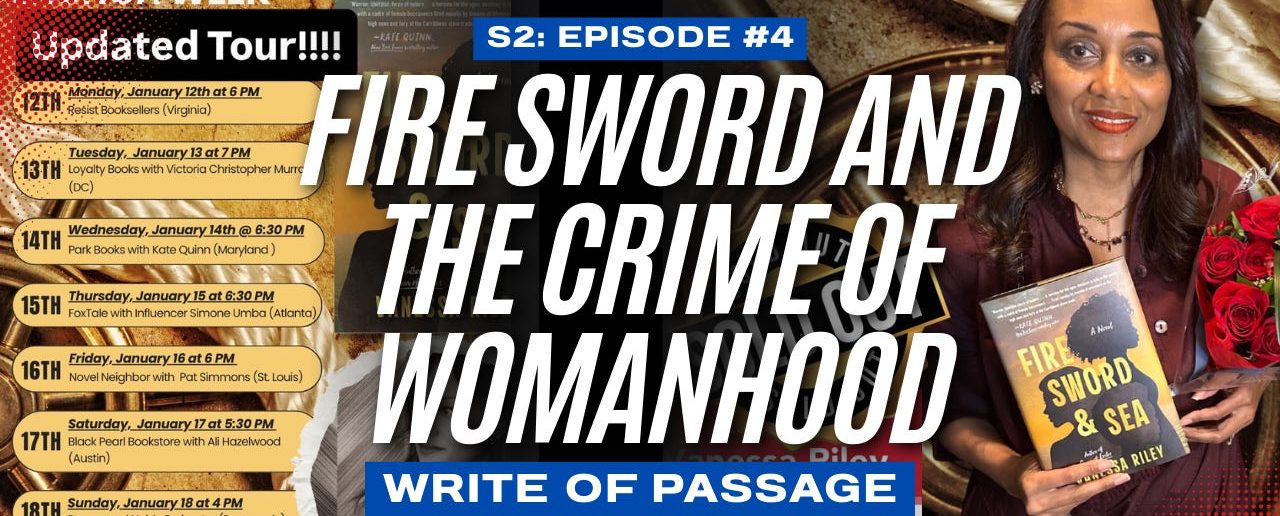
We are three and half months away from Fire Sword and Sea—Get those preorder in, and help build the momentum for this historical fiction. Please spread the word about lady pirates in the 1600s.

They are women, many our Black and Indigenous. All want a better way of life. Piracy is legal. It’s their answer. This novel releases January 13, 2026.

The link on my website shows retailers large and small who have set up preorders for this title.

Show notes include a list of the books mentioned in this broadcast.

You can find my notes on Substack or on my website, VanessaRiley.com under the podcast link in the About tab.

If you’re ready to move with purpose and power, hit that like button and subscribe to Write of Passage. Never miss a moment. We have work to do. Let me help you recharge.

Thank you for listening. Hopefully, you’ll come again. This is Vanessa Riley.

This is a public episode. If you’d like to discuss this with other subscribers or get access to bonus episodes, visit vanessariley.substack.com/subscribe

Write of Passage: Ready to Give An Account?

The rapture is said to be Tuesday. Are you ready to meet your Maker?

More importantly, are you ready to give an account for every moment you have not fully lived up to your calling? The internet is buzzing with theories and because of recent events—assassinations, and global unrest—some belie the end is near. But for those of us grounded in Christian faith, we know the truth. According to Matthew 24:36, we are told:

“But about that day or hour no one knows, not even the angels in heaven, nor the Son, but only the Father.”(NIV)

History is littered with hoaxes, false predictions of the end times that have left people swindled, embarrassed, and disappointed when life simply continued.

In 1843 and 1844, a Baptist preacher named William Miller predicted that Jesus would return between March 21, 1843, and March 21, 1844. When this did not happen, he revised the date to October 22, 1844, resulting in what became known as the “Great Disappointment.”

In 1988, former NASA engineer Edgar C. Whisenant published 88 Reasons Why the Rapture Will Be in 1988, predicting the rapture between September 11 and September 13, 1988. When his prediction failed, he revised it multiple times, first to October 3, 1988, and later to 1989, 1993, and 1994. Even engineers can be wrong.

In 1992, a South Korean religious movement led by Lee Jang Rim, called the Dami Mission, predicted the rapture on October 28; when it did not occur, Lee was convicted of defrauding his followers out of millions of dollars.

In 1997, Pastor Ed Dobson, a nationally known speaker and author, published The End: Why Jesus Could Return by A.D. 2000, arguing that the increasingly chaotic world was a sign that Jesus would return soon. While he correctly noted that the world was becoming more hectic, his prediction did not come to pass.

One of the more tragic predictions came from the Heaven’s Gate cult, which believed the appearance of Comet Hale-Bopp in 1997 was a sign that Earth was about to end, and that they had to hitch a ride on a spaceship hidden within the comet. Following this belief, 39 cult members committed mass suicide, a devastating reminder of the dangers of such predictions.

Televangelist Jerry Falwell Sr. speculated that the Antichrist would appear sometime between 1999 and 2009. While controversial and widely criticized, this prediction, too, failed to materialize.

In 2011, Christian radio broadcaster Harold Camping declared that the rapture would occur on May 21. When that failed, he revised the date to October 21, 2011, having predicted again in 1994. Again his followers, felt betrayed.

Televangelist John Hagee, co-authoring with Mark Blitz the book Four Blood Moons: Something Is About to Change, claimed that a series of four consecutive lunar eclipses from April 2014 to September 27–28, 2015, signaled the end times. The blood moons came and went, with no apocalypse in sight.

Finally, some voices in the Christian community warned that the year 2020 would signal the end, citing technological collapse, disease, or other cataclysms. While 2020 was undeniably a difficult year, the world continued, proving once again that apocalyptic predictions are best approached with skepticism.

And of course the most recently spread rumor on TikTok and repeated on other social media is another announcement for the rapture. As far as I can tell, this one is being reported to have originated by South African Pastor Joshua Mhlakela. Mhlakela has predicted that the rapture would happen on September 23 and 24, 2025, claiming the revelation came to him in a dream. Well that dream has spread like wildfire.

These examples remind us that no matter how convincing the prediction may seem, life continues—and those who place too much faith in a date are often left disappointed.

So I return to the core question: are we living in a way that truly honors our calling? For me, the answer is clear. I want to live a life worthy of the gifts God has given me—the talent to write, to speak, and to walk upright. These are not abstract abilities; they are distinct blessings that shape how I move through the world. The gift of health allows me to scale mountains, jog a mile, and experience life with vitality. The gift of speech gives me the ability to share ideas, offer wisdom, and brighten someone’s day—whether here on this podcast, in a keynote, or at a workshop. And the gift I cherish the most, the gift of writing, allows me to breathe life into characters, to refine ideas, and to share stories that resonate across time and space. Writing is where my soul finds joy.

Yet, when I reflect honestly, I know my work is far from complete. I want to reach more people, encourage those from every station and place, and see my characters come alive on television and streaming platforms. I want history told in its full context—the good, the bad, and the ugly—so that everyone can know the truth, and even see themselves in these stories. My mission is not finished until these stories are fully shared.

So yes, if the rapture truly comes tomorrow, I am not yet ready to give full account. I still have mountains to climb, stories to tell, and people to touch. And if life continues, as it often does, I remain committed to swinging for the fences, pen in hand, heart open, and ready to share.

To my listeners: thank you for allowing me to come into your homes, to share stories and perspectives, to celebrate the joys of writing, speaking, and imagining. Keep listening, keep sharing, and join our crew on this ongoing journey.

Books for those wanting to know more about the end times and how to deal with it:

Ordinary by Michael Horton does not specifically address the rapture but offers a critique of the evangelical tendency to seek extraordinary spiritual experiences. Horton emphasizes the value of ordinary Christian practices as the means through which God works in the world. More faithful living in the present, rather than fixating on speculative end-times—is what we need.

Fictional Works include:

Left Behind by Tim LaHaye and Jerry B. JenkinsA bestselling novel series that dramatizes a pre-tribulation rapture scenario, exploring the lives of those left behind during the end times.

Pat Simmons’ The Intercessors series is a Christian fiction collection that intertwines spiritual warfare, redemption, and the power of prayer, following characters who confront life’s challenges through faith and intercession. Start with Day Not Promised.

This week, I’m highlighting All Things Inspiration Giftique through their website and Bookshop.org

Check my website for the latest on Fire Sword, and Sea, pre-order and get those collector cards—because the adventure is just beginning, and there’s so much more to explore.

You can find my notes on Substack or on my website, VanessaRiley.com under the podcast link in the About tab.

I’m encouraging you to live boldly, to tell your stories, and never stop reaching for the calling you’ve been given.

Like, share, and subscribe

Thank you for listening.

Hopefully, you’ll come again. This is Vanessa Riley.

This is a public episode. If you’d like to discuss this with other subscribers or get access to bonus episodes, visit vanessariley.substack.com/subscribe