Three names: Crystal Mason. E.L.A. Chanel Miller.

Their stories are different, but each bore the brunt of injustice while others—the folks society deemed worthy of protecting—well, their futures were too promising to ruin. So they were given grace.
Until the outcry became too loud to ignore.
How loud can you scream?
Who Gets the Book Thrown at Them?
The last seven days have had my mind spinning.
On September 24, Crystal Mason was finally able to breathe.
You see, in 2018, Mason was convicted of illegal voting in Texas and sentenced to five years in prison after she cast a provisional ballot in the 2016 presidential election. At the time, she was still on federal supervised release for an earlier tax-fraud conviction, and she did not know being on supervised release made her ineligible to vote.
Her provisional ballot was never counted, but the law came for her anyway.
Think about that for a moment. A ballot that never counted. A woman who said she did not know she was ineligible. Well, that situation gave her a five-year prison sentence.
After years of appeals, in March 2024, the Texas Second Court of Appeals reversed Mason’s conviction and entered a judgment of acquittal. The court found the evidence insufficient to prove that she actually knew she was ineligible to vote.
But prosecutors didn’t want to take the L. They continued to try to revive the conviction.
But in the last seven days, on September 24, 2026, the Texas Court of Criminal Appeals—the state’s highest criminal court—rejected these efforts and left Mason’s acquittal in place.
Eight years after her conviction for casting a ballot, she’s finally free of the charges. I guess justice delayed is better than denied, right?
Then on September 25, another court confronted the disturbing use of government power. U.S. District Judge Stephanie Gallagher found the federal government in contempt after immigration authorities deported a young asylum seeker identified as E.L.A. to El Salvador despite court orders to protect him here.
E.L.A., the young minor identified in the papers, had come to the United States as an unaccompanied minor at sixteen. The government wrongly deported him, acknowledged the error and facilitated his return to the United States. Then it deported him again.
Judge Gallagher has now ordered the government to facilitate his return. One wonders what will happen, to a teen imigrant who came here seeking a better life.
So, you’re asking yourself, Vanessa, what do these two events mean?
At first glance, perhaps nothing more than two court rulings happening within twenty-four hours of each other.
But I can’t unsee who gets swept into the mashing jaws of American justice—and gets grace.
Crystal Mason is a Black woman who casts a provisional ballot and was given a 5-year sentence.
E.L.A. is an immigrant: a young Salvadoran asylum seeker who came to this country for asylum, and despite court orders, was deported. Twice.
The woman—the Black woman, and the immigrant get the harshest penalties.
Which brings me to Cornell.
On September 28, a criminal investigation was reopened into allegations involving a former Cornell University student and members of Cornell’s student Greek fraternity, Chi Phi.
Jane Doe has been trying to get justice since October 2024, because no one wanted to purse her case beyond school discipline.
In a civil lawsuit filed this month, Doe alleges that she’d been drinking, went to the Chi Phi fraternity house, was pressured to take what she was told was ketamine, became increasingly impaired, and was sexually assaulted by multiple men over a period of hours.
These are allegations. The men have not been convicted of these alleged assaults, and the reopened criminal investigation will have to determine what the evidence establishes.
One particularly disturbing part of the complaint involves an alleged Snapchat group conversation among fraternity members. According to the lawsuit, messages alerted fraternity members that a woman was upstairs and available for sex. Doe alleges that additional men subsequently entered the room and that assaults continued for hours.
She reported the incident to Cornell University Police. Cornell conducted its own disciplinary investigation. The university says the resulting sanctions included suspensions and expulsions, and Cornell permanently removed the Chi Phi chapter from campus.
But criminal charges did not follow.
Then, on September 14, 2026, Doe filed a civil lawsuit against Cornell, Chi Phi, seven former fraternity members and others, alleging negligence, sexual assault, sexual battery, breach of contract and other violations of New York law.
So today, two weeks later, Tompkins County District Attorney Matthew Van Houten announced that he was reopening the criminal investigation and present evidence to a grand jury.
And I couldn’t help thinking: Haven’t we been here before?
White young man or men, sexual assault, no punishment. Yes, we have, with the case of Chanel Miller.
In 2015, nineteen-year-old Stanford freshman and competitive swimmer Brock Turner sexually assaulted Miller, then twenty-two, after a fraternity party.
Miller was unconscious. Turner was caught assaulting her behind a dumpster. Two heroes intervened. A jury heard the evidence, and in March 2016, Turner was convicted of three felony sexual-assault offenses.
Prosecutors sought six years in prison, but Judge Aaron Persky sentenced Turner to six months in county jail, three years of probation, and sex-offender registration. Turner ultimately served about three months.
At sentencing, Judge Persky explicitly considered the consequences imprisonment would have for the convicted felon Brock Turner:
“Obviously, a prison sentence would have a severe impact on him.”
His life mattered more. The judge worried about Turner’s education, his future, and reputation, something Turner forgot about when he committed sexual assault behind a dumpster.
And what about her life?
What about the woman who woke up in a hospital and had to piece together what had happened to her?
What about the future she thought she’d have? And how this cruel act will constantly remind her of the lack of care a perpetrator and a judge had for her?
In America, whose mistake becomes criminality?
I ask that question, but it’s kind of obvious. White males from good families, going to a good school, get great grace.
Their futures are considered, not the immigrant E.L.A. facing death in El Salvador.
I don’t know what a grand jury will ultimately conclude about the allegations at Cornell. An indictment has to be handed down, then a trial will sort through facts. And of course, all that can happen is that a judge like Persky could rule for a light or non-existent punishment.
Taken together, these stories force me to see the specter of American justice. The ghosts of the past still determine who gets the book thrown at them—and whose promising future makes the world hesitate before picking up the book or throwing stones.
Maybe privilege doesn’t guarantee protection, but it definitely softens the arc of justice.
And as I look at this week, I can see how race, immigration status, money, education, and institutional prestige still determine every outcome.
No one is guaranteed to come save us from ourselves.
And too many of us don’t recognize that something is fully wrong until we find ourselves in the crosshairs of those very circumstances.
I’ve talked before about being our brothers’ and sisters’ keepers.
But right now, I also need you to focus on you.
It’s Time for Your Story
We are surrounded by messages every day telling us that we’re not important. That our experiences don’t matter. That our voices don’t matter.
I’m here to tell you the opposite.
You matter.
Your voice matters.
And your story matters more than ever.
Now is the time to write your words down before someone else writes their limited vision of them.
Tell your story. They’re banning more books and someday someone will decide yours—woman, immigrant, minority, etc. isn’t worth hearing. Bret Stephens wrote an opinion piece in the New York Times published Sept 22, (same week) accusing the National Book Award as being DEI—checks notes—for not choosing enough straight white male authors on the list.
Write it before the airways become clogged with people trying to define who you are, what your experience means, and why you shouldn’t be remembered.
Starting in October and throughout this final quarter of the year, I’m dedicating myself to teaching.
I have several teaching events lined up, and I’m excited about them. But I’m going to use this platform to teach writing—to share techniques I’ve learned and mastered and methods that have allowed me to tell the stories I needed to tell.
Because we need all our stories out there.
We are living through a profound deficit of empathy while too many people are drowning in a deficit of hope.
I believe books open doorways.
I believe poems carry us through misery to soar in triumph.
I believe stories allow one human to inhabit another’s world long enough to recognize their humanity.
I believe in you.
So we will not surrender to the drumbeat of despair.
I don’t care whether the toll comes from a government bell, a judge, a politician, an institution, a rejection letter, or simply life’s circumstances.
You are somebody.
Your story belongs here.
And I’m committed to helping you tell it, just as so many of you have helped me continue telling mine.
So buckle up.
We’re going for a ride.
This is our learning quarter.
This is our writing quarter.
Get your journals together. Sharpen your pencils. Charge your laptops. And if you haven’t subscribed, subscribe and come along.
We’re going to write.
For my paid subscribers, I’ll have worksheets and exercises to help you do the work.
Heck, I’m probably going to give a few away.
That’s how committed I am to this.
Because I want us all writing.
I want us remembering.
And documenting.
And shouting our own stories.
These last seven days have reminded me of the importance of words and writing and fear.
We may not always have our say in a courtroom. We may not be afforded the benefit of innocence or the belief that our government will follow the laws.
But we cannot stop protesting. We cannot stop being a witness to history. We cannot let evil win by disappearing from the record.
This week’s book list is some of my favorite craft books.
Beginnings, Middles & Ends by Nancy Kress — A practical fiction-writing guide to constructing compelling openings, sustaining conflict and momentum through the difficult middle, and delivering endings that fulfill the story’s original promise to the reader.
* How Fiction Works by Oakley Hall — A craft guide that uses extensive examples from literature to teach the mechanics of fiction, including plot, characterization, point of view, dialogue, word choice, voice, and style.
* The Well-Fed Writer by Peter Bowerman — A business-focused guide to earning a living as a freelance commercial writer, covering how to find clients, market your services, set rates, build a business, and turn writing into a financially sustainable career.
* Your First Novel by Ann Rittenberg & Laura Whitcomb — A combined craft-and-publishing guide that takes first-time novelists from developing and structuring a manuscript through characters and revision to approaching agents and navigating publication.
* On Writing Romance: How to Craft a Novel That Sells by Leigh Michaels — A comprehensive guide to romance writing that covers the genre and its subgenres, creating convincing romantic leads, building relationship conflict and sexual tension, crafting the HEA, and preparing a manuscript for submission.
* The Complete Handbook of Novel Writing edited by Meg Leder & Jack Heffron — A wide-ranging collection of instruction and advice from novelists and publishing professionals covering story development, character, craft, writer’s block, revision, agents, publishing, and selling a novel.
This week’s bookseller is Black Pearl Bookstore.
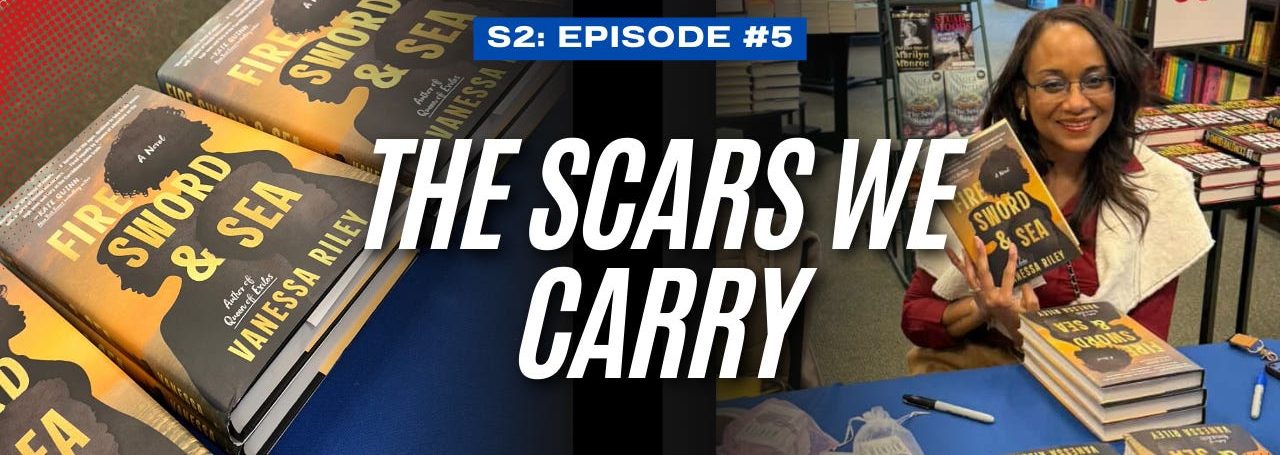
And Black Pearl might have a few signed copies of Fire Sword and Sea and can order Murder in St. James’s Park.
You can also try one of my partners in the fight, bookstores large and small, who are in the trenches with me.
You can find my notes on Substack or on my website, VanessaRiley.com, under the podcast link in the About tab.
Hey. Let’s keep rising and creating and writing together. I need you. That is the truth. Like, share, subscribe, and stay connected to Write of Passage.
Thank you for being here.
I want you to come again. This is Vanessa Riley.
This is a public episode. If you’d like to discuss this with other subscribers or get access to bonus episodes, visit vanessariley.substack.com/subscribe
