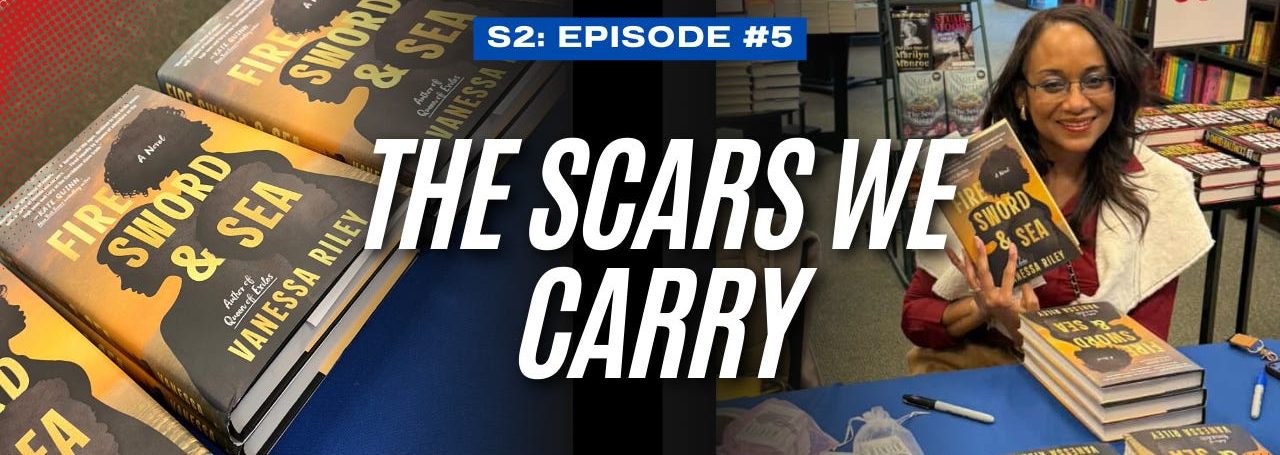
Blood. Bondage. And the ballot. People paid with their freedom—and their lives—for a right we sometimes talk ourselves out of using. Today, I want us to remember their names.

The Blood Behind Your Ballot
Nothing but the Blood and the Bondage
Today, this podcast airs on Election Day. Every Tuesday that happens, I don’t take it for granted.
Sometimes we get too comfortable in our ways. Sometimes we grow tired. And sometimes we begin to believe we are so small that our voices cannot possibly be heard.
I know that feeling. It’s why some of us stop writing. And it’s definitely why some of us stop voting.
I’m not going to tell you that life isn’t hard. It is. But before we decide that showing up won’t matter, I want us to remember what it cost the people who came before us to make showing up possible.
Some bled. Some were beaten. Some were bound to a system determined to silence them. Some were imprisoned. Some died.
All because they believed they had a right to be heard—and that we would have that right, too.
Before we get to the ballot box, let’s remember what it took to get us there.
* February 3, 1870 — The Fifteenth Amendment was ratified, prohibiting the denial or abridgment of citizens’ voting rights because of race, color, or previous enslavement. States returned to using poll taxes and other restrictions to circumvent these protections.
* April 13, 1873 — In Colfax, Louisiana, following an election dispute, armed white men attacked and killed approximately 80 to 150 Black men defending the Grant Parish courthouse.
* 1877 — Georgia made its poll tax cumulative. So prospective voters could be required to pay accumulated unpaid taxes for missing elections, creating more barriers to voting. For the next twenty years, poll taxes became a central means of Southern disenfranchisement. Payment requirements operated alongside literacy tests and intimidation. They targeted Black political participation but also excluded many poor white citizens.
* November 10, 1898 — In Wilmington, North Carolina, white supremacists killed Black residents and forced out the city’s legally elected diverse government. The death toll recorded by the coroner was 14, but a commission in 2006 estimated as many as 60 murders.
* March 3, 1913 — Women were assaulted as they walked in Washington, D.C.’s Woman Suffrage Procession. Approximately 100 marchers were taken to Emergency Hospital.
* October 20, 1917 — In Washington, D.C., two women, Alice Paul and Rose Winslow, were imprisoned for picketing outside the White House to demand women’s voting rights. After being sentenced for obstructing traffic, they went on a hunger strike, were force-fed, and Paul ended up in the psychiatric ward.
* November 14–15, 1917 — Arrested for picketing the White House while trying to get President Wilson to support a constitutional amendment securing women’s voting rights, Lucy Burns, Dora Lewis, Mary Nolan, and Alice Cosu were sent to Occoquan Workhouse in Lorton, Virginia, where they were brutalized by the guards in the “Night of Terror.” Dora Lewis was knocked unconscious. Mary Nolan was dragged despite her disabled foot. Alice Cosu suffered a heart attack.
* August 26, 1920 — The Nineteenth Amendment was certified. It prohibited voting discrimination because of sex. Poll taxes were used to burden women, especially those whose husbands or fathers controlled the household money.
* November 2, 1920 — In Ocoee, Florida, Moses “Mose” Norman was denied the right to vote on the grounds that he had not paid his poll tax. The dispute led to a white mob committing violence. Julius “July” Perry was lynched. Black homes were burned. In the Election Day massacre, the disputed death toll is as high as 60.
* December 6, 1937 — In “Breedlove v. Suttles”, the Supreme Court upheld Georgia’s poll-tax requirement.
* November 1942 — Southern senators filibustered anti-poll-tax legislation. The Senate’s historical account describes the taxes as a means of disenfranchising low-income voters, including many African Americans.
* December 25, 1951 — The home of Harry T. and Harriette V. Moore, who led Black voter registration, was bombed on Christmas Day. Harry died December 25; Harriette died January 3.
* May 7, 1955 — In Belzoni, Mississippi, Reverend George W. Lee, who was a voter-registration organizer, was shot and killed.
* August 13, 1955 — In Brookhaven, Mississippi, Lamar Smith, a World War I veteran active in voter registration and local elections, was shot and killed outside the courthouse.
* September 9, 1957 — The Civil Rights Act of 1957 was signed, creating the U.S. Commission on Civil Rights and strengthening federal authority to pursue voting-rights violations.
* May 6, 1960 — The Civil Rights Act of 1960 was signed. This required the preservation of voting records and expanded federal remedies against discriminatory registration practices.
* September 25, 1961 — In Liberty, Mississippi, Herbert Lee, a farmer who helped recruit people for voter-registration classes, was shot and killed by state representative Eugene Hurst.
* June 9, 1963 — In Winona, Mississippi, Fannie Lou Hamer was arrested and brutally beaten in jail when she returned from a voter-education workshop. She survived.
* June 12, 1963 — Jackson, Mississippi: Medgar Evers, the NAACP’s Mississippi field secretary, was shot and killed outside his home.
* January 23, 1964 — The Twenty-fourth Amendment was ratified. It prohibited denying voting rights because of failure to pay a poll tax or other tax in federal elections.
* June 21, 1964 — In Neshoba County, Mississippi, James Chaney, Andrew Goodman, and Michael Schwerner, civil rights workers working on Freedom Summer’s voter-registration campaign, were murdered in a conspiracy involving Klansmen and a deputy sheriff.
* July 2, 1964 — The Civil Rights Act of 1964 was signed and addressed discrimination in voting, public accommodations, education, federally funded programs, and employment.
* February 18, 1965 — In Marion, Alabama, Jimmie Lee Jackson was fatally shot by a state trooper. His death helped spur the Selma-to-Montgomery voting-rights march.
* March 7, 1965 — In Selma, Alabama, state troopers and other officers attacked approximately 600 peaceful voting-rights marchers at the Edmund Pettus Bridge in what is called Bloody Sunday. Fifty-eight people were treated for injuries at the local hospital, including John Lewis, who suffered a fractured skull.
* March 9, 1965 — In Selma, Alabama, after participating in a peaceful march, Reverend James Reeb and fellow ministers Orloff Miller and Clark Olsen were walking toward a movement meeting at Brown Chapel AME Church when white segregationists attacked them. Reverend Reeb was killed.
* March 25, 1965 — On U.S. Highway 80 in Alabama, Klansmen shot Viola Liuzzo between Selma and Montgomery after she helped transport Black voting-rights marchers. Her passenger, Leroy Moton, survived.
* April 27, 1965 — In “Harman v. Forssenius”, the Supreme Court rejected Virginia’s poll-tax workaround.
* August 6, 1965 — The Voting Rights Act was signed, establishing powerful federal tools against racial discrimination in voting, including advance review of voting changes in covered jurisdictions. It also directed the attorney general to challenge remaining poll taxes in state and local elections.
* January 10, 1966 — Near Hattiesburg, Mississippi, Klansmen killed Vernon Dahmer. They firebombed his home and store after a radio announcement publicized his help with Black voter registration and poll-tax payments. His wife and three children escaped, but his daughter, Bettie, suffered severe burns.
* March 24, 1966 — In “Harper v. Virginia State Board of Elections”, the Supreme Court prohibited poll taxes in state elections. The Court held that making payment of a fee or a voter’s wealth an elec…
This is a public episode. If you’d like to discuss this with other subscribers or get access to bonus episodes, visit vanessariley.substack.com/subscribe
