In our poll a few weeks ago, several of you indicated you’d like to see more profiles of historic Regency figures. That got us talking about various people we could feature. So this month we asked our authors who they thought was one of the most intriguing figures from the Regency era.
Lord Byron. Photo: wikimedia commons
Ruth Axtell
Lord Byron, for me, I think.
Susan Karsten
Neither of my most-intriguing Regency figures is very “cool” noble-character-wise, but I am interested in Hariette Wilson and Beau Brummel. Though I suppose she, with her loose morals and fly-in-the-face of society’s mores attitude, and he, with his obsession with surface and image, would be considered cool in the world of today. I intend to do a blog post on Wilson in a few days — so watch for it.
(We’ve mentioned Beau Brummel on this blog before. Check out Mary Moore’s post about Brummel and his influence on society.)
Jane Austen
Kristy Cambron
I love Jane Austen – she will always be in my heart as my first introduction to British wit and brooding heroes. : )
Vanessa Riley
That would be Jane Austen. Her wit and turn of phrase still haunts my dreams, but in a good way.
(Do you love Jane Austen? Keep an eye on this blog! August is Austen month here at Regency Reflections and we’ll be celebrating Jane Austen and Pride and Prejudice.)
Laurie Alice Eakes
Mrs. Radcliffe. I want to meet one of the hottest selling authors of the Regency. (Mysteries of Udolpho)
Sarah Villiers, Countess of Jersey
Kristi Ann Hunter
I’m going to go with Lady Jersey and the others of her ilk. The whole idea of the Queen Bee fascinates me. I love looking at them and trying to figure out what about them made them the one who got to dictate what was right and proper to everyone else. While we have the rankings to make some sense of certain women’s rise to social power, there are certainly other factors to consider.
What about you? Who do you find fascinating from the Regency Era? Anyone in particular you’d like to see us do a post on?
I recently read an older biography of Jane Austen entitled Presenting Miss Jane Austen. It was written by May Lamberton Becker and published in 1952. It was well-researched and endorsed by the Jane Austen Society.
What intrigued me the most, however, was a short section in Chapter Thirteen about one of the summer journeys Jane and her sister Cassandra took while they were living in Bath. One of the things Jane most looked forward to living in Bath was spending summers at the seashore. This was a new vacation destination for regency society, who had up to then been accustomed to going to the watering holes of Bath and Tunbridge Wells. But with the Prince Regent preferring to spend his time at the seashore in Brighton (which grew up around the original settlement of Brighthelmstone), the Brits took to the sea.
Jane writes about this new mobilization in a satirical way in one of her unfinished novels Sanditon, in which a resort town is being constructed around a traditional fishing village. You can see her humor in the town’s name which sounds suspiciously like “Sand Town.”
It was on one of these summer jaunts that Jane and her sister met a young clergyman at one of their stops. Perhaps it was in Devonshire, the author speculates. This clergyman was visiting his brother, a doctor. Her sister Cassandra is quoted in one of her letters as saying he was “one of the most charming persons she had ever known.” When they continued their journey, this gentleman asked permission to join them farther ahead in another town. According to the author, permission was given, which in these more formal times, meant a tacit agreement of a serious intention. When the sisters arrived at the town, Jane received a letter announcing his death.
Fast forward to more recent times when a literary biographer, Dr. Andrew Norman, has written a book called Jane Austen: An Unrequited Love (2009). He claims the identity of this mysterious gentleman is the clergyman Dr. Samuel Blackall, the brother of Dr. John Blackall, a physician. It seems Jane met him years earlier in 1798, when the two were guests of mutual friends, the Lefroys (one of whom, Tom Lefroy, is depicted as Jane Austen’s love in the movie In Becoming Jane).
Four years later they seem to have met again on the southern coast of England in the town of Totnes in Devon. Norman says she was visiting this town with her parents and met and fell in love with a clergyman who was visiting his physician brother who worked there.
Until then no one knew the name of this mysterious clergyman. But Norman searched the town records until uncovering the name of one physician, a Dr. John Blackall. He put two and two together and concluded that this is the same family Jane had met earlier at the Lefroys.
Very few of Jane’s letters survive from the years directly after this meeting, between 1801-1804. Norman says that Blackall did not die but married someone else in 1813.
So, who knows what really happened. I prefer the first biographer’s conclusion, that Jane and this young clergyman did meet and fall in love and then he died prematurely. Jane loved him to her dying day, and her feelings are reflected in that famous quote from her novel Persuasion in which she debates who loves longest, men or women: “All the privilege I claim for my own sex (it is not a very enviable one, you need not covet it) is that of loving longest, when existence or when hope is gone.”
We shall never know whether or not a man name Robert Coates, come to known as Robert Romeo Coates, thought himself a brilliant actor, or if the farcical manner in which he played roles like Romeo were done as parody. What we do know is that he walked out on stage in a flowing cloak and tight pantaloons in blue and red, his garments sprinkled with diamonds, and proceeded to butcher the role of this tragic Shakespearean hero. His garments were so tight he moved stiffly.
“We are not disposed to be severe on Mr. Coates performance,” reports Kirby’s Wonderful Magazine in 1815, “which afforded singular amusement; but it is necessary, in order to give a just idea of it, to say, that for some time it was not so much below mediocrity, that it appeared likely to pass off in that flat routine which is neither forcible enough to affect the feeling in the pathetic, nor absurd enough to amuse by provoking risible faculties. At length a sudden start, or rather frisk and jump, in one of the love speeches, called forth so universal a burst, and from that moment the laugh was not discontinued, nor the audience composed for one instant to seriousness, for the remainder of the night; and whether Romeo addressed Juliet; or Juliet pronounced the praise of Romeo, laughter convulsed the house, and made it sometimes impossible for the love-sick maid herself (though represented in a very superior manner by a young lady of the name of Watson) to forbear from a smile and a titter, where a sob and a tear would be appropriate, if the tragedy had not been so superlatively commedyized, or rather farcified by her lover.”
Mr. Coates was not a professional. He only took to the stage for charitable events; however, every time he did, the houses were packed with audiences who ended up laughing themselves sick. After a while, actresses refused to play opposite Mr. Coates and theater managers refused to let him take to the stage, even with the bribes he was known to offer them.
You see, gentle reader, Mr. Coates was a wealthy man. The only survivor of a wealthy West Indian planter, he moved to Bath, where he had caused to be built, a curricle. “It was literally covered with brass cocks; the saddle of the horses (weighing fourteen pounds) as well as the buttons and buckles of the harness, and every ornament that could be turned into a cock, wore the resemblance of that biped; even the buttons on his servants coats were stamped with a cock; …”
Is it any wonder that boys crowing “Cock-a-doodle-doo” often followed him through the streets?
Mr. Coates was not all amateur actor, over-dressed dandy and flamboyant whipster. He also held strong principles on matters such as gambling. He didn’t do it. The idea he would do so offended him, as he claimed he had enough (money) and intended to spend it himself.
He did spend it, building a new curricle of whimsical design after the first was wrecked somehow. Eventually, he fell into financial difficulties and retired from his outrageous lifestyle for a while. In this time, he married a well-bred young lady, got financially on his feet again, and lived a quiet, respectable life until he died in a street accident in the 1840s.
Of all the colorful characters the Regency produced, Robert Romeo Coates is one of the most colorful of them all—quite literally. Probably to the relief of Mr. Shakespeare, no one has ever performed the role of tragic Romeo quite like Mr. Coates, nor have audiences laughed until they cried during this tragedy, instead of simply crying.
Betrayal leaves no visible wound, only a hardened place in the heart—scanned, protected, and difficult to penetrate. The question becomes, do we want to heal, or can we linger in hate and fire?
Betrayal is one of the most disorienting experiences a person can endure. It does not arrive all at once; it sweeps through you in stages, much like grief. First comes shock, then self-doubt. Was I naïve? Was I fooled? Were there signs I ignored because I wanted to believe? You replay conversations, gestures, moments of connection, wondering which parts were real and which were carefully constructed illusions. There is a particular cruelty in realizing you were allowed—invited—into a false sense of security.
What makes betrayal hurt the most is not just the deception, but the bond you believed you shared. Often, trust is built. Often values are mirrored: bonding on marginalization, feminism, activism, or other deeply held beliefs. You thought we saw the world the same way.
And with this bond, one can say, I’m not alone, not alone in the mission, not alone in the place and time. Basically, I’m not alone or lonely anymore.
Finding a like-minded person can feel like hope in an isolating world. And when that bond proves false, it shakes more than the relationship—it shakes your foundation, your sense of reality. You begin to question everything. What was authentic? What was performative? And inevitably, the most haunting question surfaces: If I can be misled, how do I trust again?
This question lives at the heart of Fire Sword and Sea. Jacquotte Delahaye wrestles with trust at every stage of her life. As a cook in a tavern, she must decide who entering the building is safe, and who is not.
When Jacquotte becomes a pirate, she’s surrounded by a crew whose survival depends on loyalty; that question becomes life-or-death. In love, it becomes even more perilous: who deserves her heart, and who should she flee from? We all recognize the trope of the “bad boy, bad girl”—and even then, there’s an understanding of risk.
Hoping to expand our happiness, and unfortunately, to our detriment, we try. Then we fail, and every reason that seemed right masked all those wrong reasons.
In Jacquotte’s story, betrayal cuts sharply when it comes from a friend, someone she would die for. The wound left behind is unforgettable. Her heart leans to be more guarded. As readers follow her journey, I wish for them to reflect on their own lives: and asking the tough questions:
Where are they most vulnerable?
Where does trust feel most fragile?
How do they respond when someone they love or admire proves to be painfully human—or worse, willfully harmful?
Recovery from betrayal is difficult, especially when it comes from someone you love. It hurts down deep when your admiration was for naught.
Yet living with a grudge is harder. Holding on to ill will and being unable to forgive is terrible. These conditions are like living behind armor so heavy it prevents connection altogether. No one wants to become the person who’s constantly looking over their shoulder, questioning every kindness, every soft word. And yet, as a member of a marginalized community, I can say that this struggle is familiar. Betrayal is not theoretical; it is lived.
President Reagan famously said, “Trust, but verify,” when referencing his mortal enemies. The word enemy implies intention, while mortal suggests an endgame. Jacquotte survives betrayal.
Mostly.
She carries with her a scar—a hardened scab over part of her heart.
The scab is protective. It’s tender. Difficult to penetrate.
One of the most personal and honest aspects of Jacquotte Delahaye’s character is how she navigates betrayal while balancing mercy, forgiveness, awareness, and pain. She is not idolized. She is real. A crew member betrays her profoundly, and yet she must decide how to move forward, because leadership demands clarity. If you are on her crew, she must be prepared to sacrifice everything for you.
I’m not suggesting anyone make unwise sacrifices for those who’ve harmed them. Some acts are unforgivable.
But we live in a moment that demands deeper conversations about accountability, justice, and grace. There’s a growing urge to harden our hearts—to refuse forgiveness entirely—especially when apologies arrive only after consequences. And yet, we must weigh these decisions carefully, as captains of our own ships.
I do not claim to have the right answers. The Jacquotte I wrote doesn’t. She is flawed. She walks a delicate balance between forgiveness and holy anger.
So I think about Jacquotte. As I went on a release week tour, she was on my heart. She lived an experience that left marks, taught her caution, and forced us to decide who she’d become in the aftermath.
In life, the question is not whether we will be wounded, but when to choose healing—and what parts of ourselves we are willing to risk again.
Explores betrayal among friends and how certain ruptures change lives forever.
Fire Sword and Sea by Vanessa Riley. This is a fast paced saga that illustrates betrayal and community.
These are fictional accounts. We need good fiction to help us escape disappointments to learn to master forgiveness and fire.
This week, I highlight Black Pearl Books. You guys are amazing. Thank you for the hospitality in Austin.
Consider purchasing Fire Sword and Sea from Black Pearl Books or from
one of my partners in the fight, bookstores large and small, who are in hanging with me.
Come on, my readers, my beautiful listeners. Let’s keep everyone excited about Fire Sword and Sea.
You can find my notes on Substack or on my website, VanessaRiley.com, under the podcast link in the About tab.
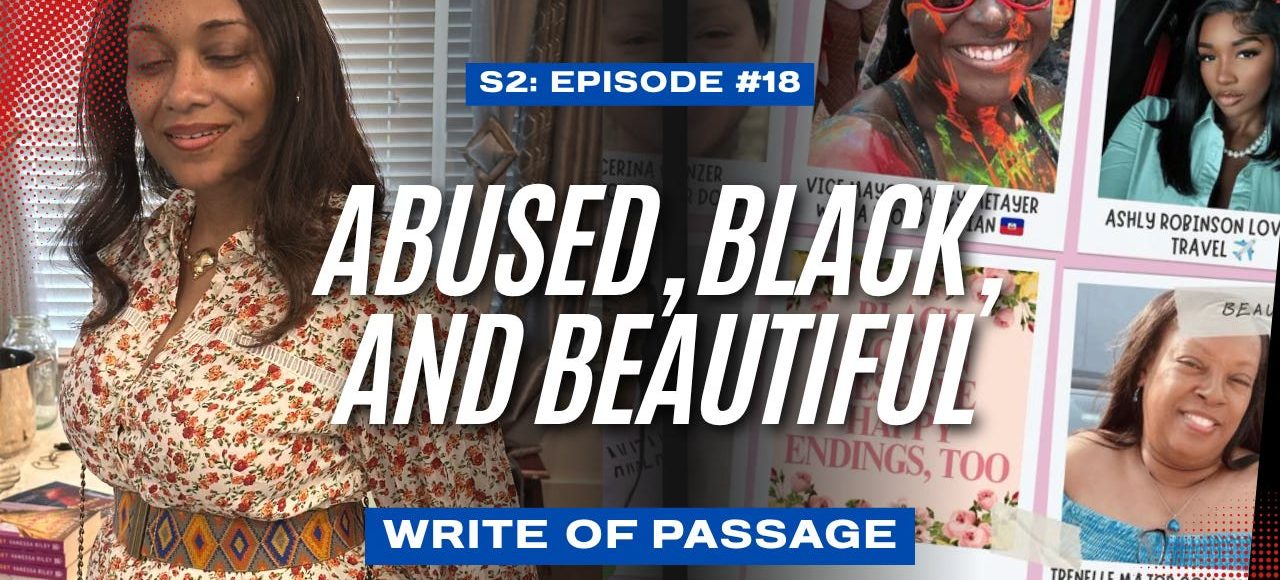
Enjoying the essay? Go ahead and like this episode, share, and subscribe to Write of Passage so you never miss a moment.”
Thank you for listening. I want you to come again. This is Vanessa Riley.
This is a public episode. If you’d like to discuss this with other subscribers or get access to bonus episodes, visit vanessariley.substack.com/subscribe