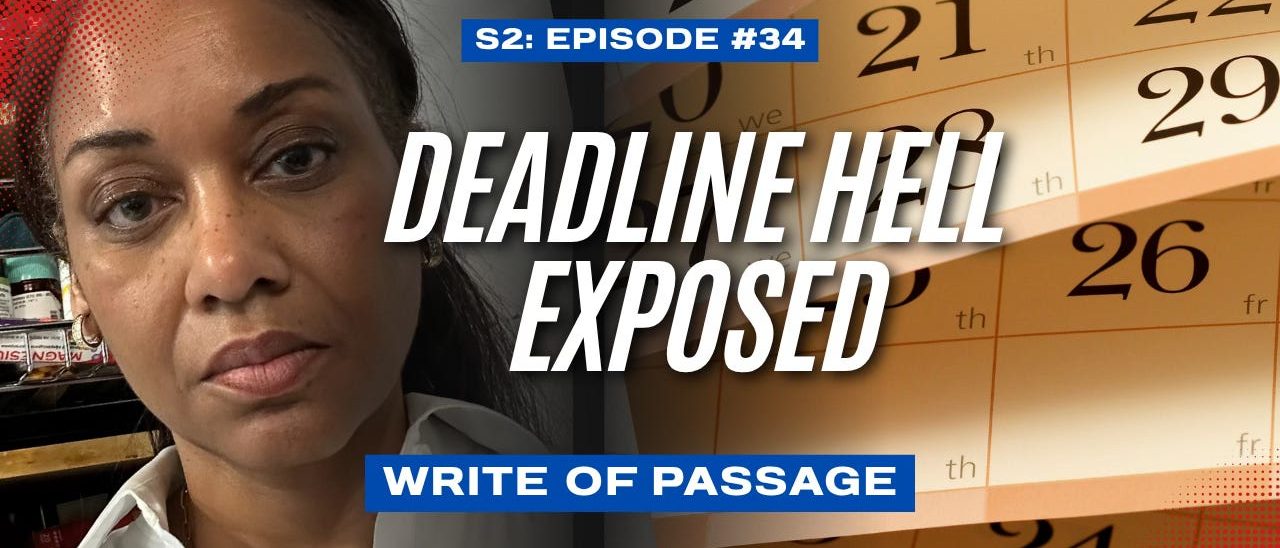
Flights stopped. Microsoft went down. Banking stalled. Even the biscuits came with a warning. Chaos was everywhere—but I still had words to write. When everything feels broken, pick up your pen. Let me tell you why.

When Everything Breaks, Keep Writing
This week, I sat down to think about what I wanted to talk about on Write of Passage. Something useful. Something encouraging. Something about how we keep writing when life refuses to cooperate.
And apparently, the week heard me.
“Oh, you want to talk about chaos? Let me demonstrate.”
While I was in Kansas for a Writers Conference for Johnson County Library, Microsoft services went down. Flights stopped departing. Banking transactions slowed. And somewhere in the middle of all that, I came across a story about everything bagels and positive drug tests.
They really are putting everything on those bagels.
Now, before we turn breakfast into a criminal enterprise, let’s look at the timeline.
On Thursday November 12, a major Microsoft outage disrupted Outlook, Teams, and other services. Microsoft reported full recovery on Saturday, after more than twenty-four hours of disruption. That is a long time when you have emails to send, meetings to attend, and people waiting on your work.
I had a presentation to deliver at the conference and suddenly, access to PowerPoint was something I had to worry about.
Then, on Friday, November 13, a telecommunications problem prompted a nationwide air traffic ground stop. Planes didn’t resume flying until five hours layers. Traffic was still affected on Monday.
But Monday said to hold my beer. On November 16, JPMorgan Chase and Bank of America reported a software bug slowing down transactions. Chase said customers still had access to their accounts and funds and that operations were back to normal Monday evening.
And then breakfast joined the chaos. Beyond the scare of dope laced bagels, the USDA issued an announcement on Saturday, November 14 that ready-to-eat meals containing biscuits might be contaminated with Listeria. Biscuits! The planes weren’t departing, email wasn’t cooperating, banking transactions were dragging, and now I had to investigate breakfast. Can a woman at least have her biscuits and gravy in peace?
So yes, chaos volunteered to be this week’s topic.
What do we do with it? How do we keep writing when the tools, the schedule, and possibly breakfast have become unreliable?
I have some thoughts.
First, take a breath. Don’t give the disruption your whole day.
I’d say relax and get to it, but that sounds like a song, but there is utility about keeping your wits
When something stops working, our minds can move very quickly from inconvenience to catastrophe. An email won’t send, and suddenly we are imagining the lost opportunity, the angry response, the consequences of a deadline miss.
Our minds spin with the possibilities of what comes next.
These disruptions were serious. People had places to go, work to deliver, and payments to make. But we need to also note that each system recovered. Planes started moving. PowerPoint loaded. Transactions resumed. Don’t know about those biscuits.
Knowing that recovery is possible can help us from becoming frazzled and treating each disruption as permanent.
But what can I do in the midst of the storm?
For me the answer is writing. Writing is a good way to wait.
Take the breath. Write out your plans and fears and hopes, or novel obligations and wait to make the next decision with the information you actually receive from trusted sources.
Second, disaster proof your words.
One time, I lost a complete book. My WIP for Madeline’s Protector was solely kept on a single hard disk that went bad. I mean very bad. I spent $800 to try and recover the manuscript. The recovery service used a clean room to open up the disc and get the data out. In hindsight, since I rewrote that manuscript again and again and again, I probably should have saved the money, but everybody understands how dire things feel in the moment when you need to get back those words.
Now I use several methods of making sure my work is protected. I keep copies on Dropbox. I have copies on my desktop computer. Sometimes I’ll email a draft to myself just to make sure I have a backup copy.
In addition to having copies on Dropbox or Apple storage, I print a version of a presentation to take with me. I carry a notebook in my bag. I use the notepad on my phone to leave myself a sentence about what happens next in the book I’m drafting. I’m now the queen of word contingencies.
Third, use the disaster to provide another entrance into the work. What if your characters experienced a similar or equally devastating disaster, how does it change them?
How do they handle getting stuck or missing a presentation? How do they begin again? What can you learn from them? And remember as your characters are working
through their chaos, your readers might be living through chaos, too.
While readers have their own delays, missed responsibilities, disappointments, a story can give them somewhere else to go. It can become a model of how to keep calm and carry on, or mirror to let the tears and frustrations and grief flow.
There is pleasure in entering a story and trusting the writer to carry us through it. We can follow a protagonist into danger, grief, desire, or uncertainty because we want to discover what comes next.
And yes, all these chaos and disruptions can provide material.
Imagine the lovers whose reunion depends on a flight that’s been grounded. The apology sitting in an email box that will not send. The dinner date complicated by a payment that refuses to process. An allergic reaction to a breakfast sandwich can be extremely disrupting.
A writer can imagine these moments and make us feel the pressure. Your present chaos can be an experience that you remember, that can be used to build a character’s emotional arc.
And above all, your words may not only be an escape or instruction, but it can also become part of how a reader gets through a difficult moment.
So take a breath. Find your way back to your pages. Remember who might be waiting on the other side of it of it “getting done.”
This week’s book list includes:
* Bird by Bird: Some Instructions on Writing and Life by Anne Lamott — A funny, compassionate guide to tackling overwhelming writing projects one manageable piece at a time.https://bookshop.org/a/95/9780385480017
* Keep Going: 10 Ways to Stay Creative in Good Times and Bad by Austin Kleon — Practical encouragement for sustaining your creativity when distractions, burnout, and everyday chaos threaten your focus.https://bookshop.org/a/95/9781523506644
* Remembered Rapture: The Writer at Work by bell hooks — Essays celebrating the writing life, the creative process, and the lasting power of words to connect and sustain us.https://bookshop.org/a/95/9780805059106
And order them through The Novel Neighbor, a women-owned independent bookstore and community gathering space in Webster Groves, Missouri, in the St. Louis area. Support Novel Neighbor through the Bookshop.org links above—or, if you’re visiting the St. Louis area, stop by and browse the shelves.
Remember to check my Resources Center on my website for my writing downloads. Lots of free and low-cost tools that I’ve made available to help you on your writing journey.
You can find my notes on Substack or on my website, VanessaRiley.com, under the podcast link in the About tab.
If this podcast sparked something in you, show me some love—hit like, share the episode, and subscribe to Write of Passage!
Thank you for being here.
I want you to come again. This is Vanessa Riley.
This is a public episode. If you’d like to discuss this with other subscribers or get access to bonus episodes, visit vanessariley.substack.com/subscribe
